A suburban city near Austin tried to beautify with a parking ordinance, but city leaders are rethinking it.


"The Leander City Council hoped last summer that an amendment to its parking ordinance would help beautify the town, but it instead ended up causing headaches for some residents left with nowhere to park in their neighborhoods.
Tonight, the council will discuss ways to fix the amendment, which passed unanimously in July and is meant to get people to stop parking on their lawns. The ordinance prohibits residents from parking on unpaved surfaces.
But the new rules have unintentionally made it complicated for some residents to find a lawful place for their vehicles, council members said.
'We have some old driveways that are only one single car width,' resident Bill Finley said of his County Glen neighborhood. 'There are multiple vehicles that don't have any place to park. It's a nightmare shuffling the cars around.'
Finley's neighborhood was built before the city imposed housing and road standards, so his streets are narrow and most of his neighbors have small driveways, if they have a paved driveway at all.
They can't park on the street because it obstructs the roadway. And they can't park on gravel driveways or the bar ditch in front of their homes anymore because it's now against the rules."
Read the full story: Leander could ease off parking restrictions
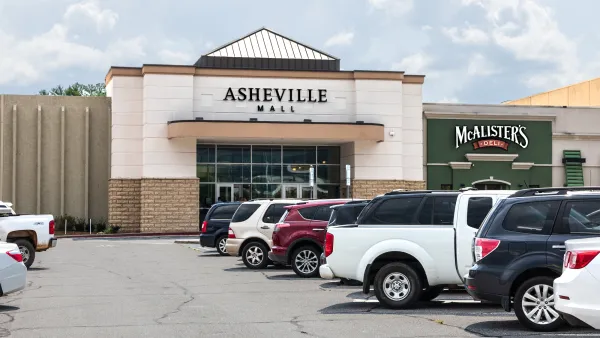
Asheville reconsiders parking minimums as surface parking eats up over a third of downtown real estate
Housing advocates say parking requirements are unnecessary and induce sprawl.
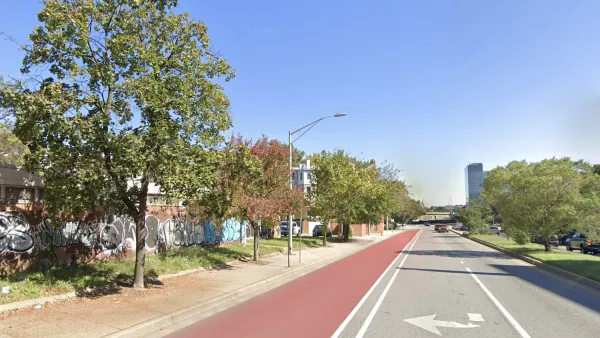
In a twist, Baltimore residents ask for less parking
A grocery store developer is asking to build more off-street parking than the city's new regulations allow, as well as 6 curbside spots that would replace an existing bus lane.
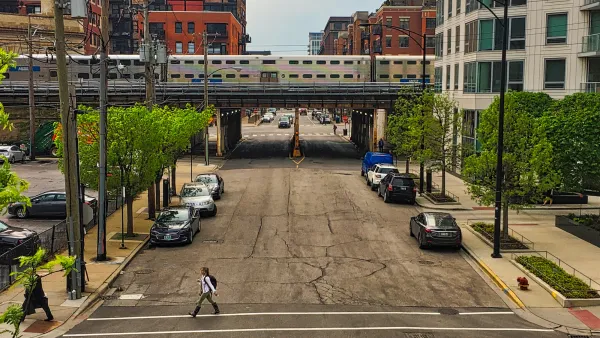
Chicago eliminates parking requirements near transit
In 2025, Illinois barred cities from mandating parking near train and bus stations.

Planetizen Federal Action Tracker
A weekly monitor of how Trump’s orders and actions are impacting planners and planning in America.

Eastern Nebraska is running out of electricity
Data centers and electrification are straining eastern Nebraska’s grid, throttling economic development.

Study reveals best places in the U.S. for cycling, walking
New research from Streetlight Data examines bicycle and pedestrian miles per capita in the 100 largest U.S. cities by population.

DSA members accuse Mamdani of 'abandoning values' over housing redevelopment
New York City's mayor plans to replace about 2,000 units of public housing with private, mixed-income housing.

All sides of BRT debate unhappy with CDOT’s most recent move
The Colorado Department of Transportation is no longer considering center-running bus lanes for Colorado Boulevard.

Massachusetts bogs generate both power, and cranberries
Putting solar panels above farmland is one way Massachusetts is advancing toward its goal of net-zero carbon emissions by 2050.

FREE Course: Walkable City 1: Why Walkability?
After describing his path towards focusing on walkability as the essence of good planning, Jeff Speck marches through his five principal reasons for making more walkable places.
Reinventing Malls: Planning Alchemy—Turning Gray Fields Into Gold
The course focuses on the opportunities and imperatives that shape reinvention of mall sites.

City of Rosemead
Rutgers University, Edward J. Bloustein School of Planning and Public Policy
One Hundred Miles
University of Michigan School for Environment and Sustainability (SEAS)
Hunter College, City University of New York (CUNY)
The Architects Foundation
City of Cambridge
The Pocatello Development Authority
The Urban Renewal Agency of the City of Pocatello