The 'Subway to the Sea' project in Los Angeles isn't just about transportation- it also opens up a world of development opportunity, say architects Ernesto Vasquez, AIA and Jeff Mayer, AIA of MVE & Partners.


With the passage of Measure R in November, the voters of Los Angeles County determined to set aside $40 billion for mass transit, including that longest-simmering of metropolitan infrastructure dreams, the "Subway to the Sea."
The route and station stops for the Subway to the Sea have yet to be determined, although the front-running plans are westward extensions from either the Wilshire-Western subway stop, underneath Wilshire Boulevard to the sea, or from the Hollywood-Highland stop, tunneling west below Santa Monica Boulevard.
The Subway to the Sea will no doubt become one of the most memorable mass transit projects of the era-and yet it is also something much larger: A once-ever opportunity to responsibly boost and channel real estate development through the Westside, creating a connected, less-congested and breathing city. The Subway to the Sea has the potential to be not only tunnel and trains, but rather a necklace of urban jewels, known more prosaically as 'transportation-oriented developments,' or TODs.
Though thought of as a transit agency, the Los Angeles County Metropolitan Transportation Agency (MTA) - builder of the Subway to the Sea - is actually the region's stealth developmentagency, much more powerful than any other entity that bears such a title. Unlike other development agencies in name, the MTA can not only determine subway stop locations, but then can strongly encourage large-scale real estate development on and around subway stops-which is exactly where future construction should take place.
Scarcely known to the public, or even local urban planners, is the fact that the MTA has the power of eminent domain, in addition to its legal authorization to buy land. Indeed, not only does the MTA obtain land for subway stops, it must buy surrounding parcels for 'staging areas,' so that the heavy work of building underground can proceed. These staging areas become surplus when the subway stops are finished, creating a perfect opportunity for dense, omni-use development. The MTA, in fact, has already proceeded down this very course by undertaking 'joint development' on MTA subway properties, most notably the huge Hollywood/Highland mall - the star-crossed yet still catalytic and successful development in the revitalized Tinseltown - and also at its Hollywood and Vine stop.

The exciting reality is that the MTA must do more of the same on the Subway to the Sea, but on an even larger and more sophisticated scale. In assembling land parcels for the project, the MTA might do well to overshoot, and buy more rather than less. Then, working in concert with private developers to better assure market validation, the MTA should move forward with dense, mixed-use TODs, creating lively, breathing, vital 'urban villages' or 'mini-cities' around each stop.
Ideally, such subway neighborhoods should be somewhat self-sufficient to encourage walking-having such amenities as grocery stores, dentist offices, paseos and libraries-but also be inviting to surrounding streets. National design competitions should be held for each subway neighborhood, to help assure that evocative or iconic architecture rules the day. It is liberating to consider that among its many strengths, Los Angeles has a complete lack of suffocating context-any architectural style could fit in West Los Angeles, from Streamline Moderne to Tuscan. Imagine a string of subway neighborhoods, each remarkable for its beauty, vitality and functionality. What is truly remarkable is that with the passage of Measure R, such a vision is not so utopian as practical, possible and necessary.
Subway neighborhoods would not only provide homes for the inevitable growth in Los Angeles' population, they can also relatively reduce traffic-the greater the number of subway neighborhoods, the greater the chance a resident can become a commuter who rides the subway to work, a reveler who visits nightspots in the evening by the tube, or a parent who takes the family to the beach by rail come Sunday.
With the Subway to the Sea, we can make Los Angeles a better city to live in, reduce congestion and pollution, and help preserve and enhance property values. It is a time for bold visions.
Ernesto Vasquez, AIA, Vice President and Partner of MVE & Partners, believes that smart and beautiful architecture improves the urban environment and provides transcendent experiences for metropolitan denizens. Among many other projects, Vasquez designed Fruitvale Village, a transit-oriented development on a BART stop in Northern California. Vasquez holds a Bachelor of Architecture degree, with honors, from the College of Architecture and Environmental Design (CAED) at California State Polytechnic University, San Luis Obispo, where he is a member of the CAED, and has served on the President's Council.
Jeff Mayer, principal of Irvine-based MVE & Partners, is also the current Chair of the Orange County District Council of the Urban Land Institute (ULI). Mayer is widely recognized for more than 30 years of accomplishments in the architectural field, including master planning, strategic planning, feasibility analysis, entitlement planning, interiors, entertainment design and and "edutainment" architecture. Mayer earned a Bachelor of Science in Planning and Landscape Architecture from the University of Virginia and completed graduate work at the Wharton School of Finance at the University of Pennsylvania.

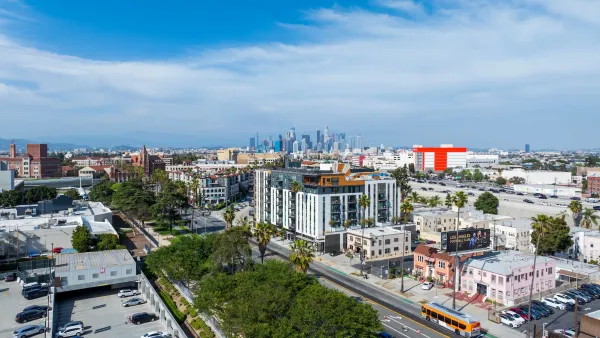
LA delays state housing mandate with 'low-rise ordinance'
The new ordinance allows the city to delay implementing SB 79, a state law requiring more density near transit.
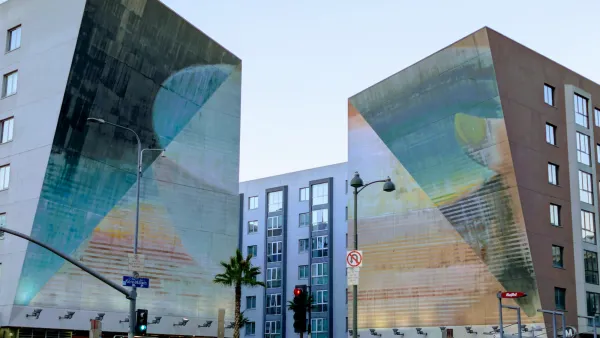
LA Metro Opposes TOD Law, Fearing Backlash to Transit Expansion
Metro wants an exemption from California’s new housing law, despite the law’s potential to increase ridership by putting more housing near transit stations.

California TOD Law Gives NIMBYs a new Weapon Against Bus Lanes
A new law that allows rezoning for higher density near transit lines is fueling opposition to a Burbank bus rapid transit line.

Planetizen Federal Action Tracker
A weekly monitor of how Trump’s orders and actions are impacting planners and planning in America.
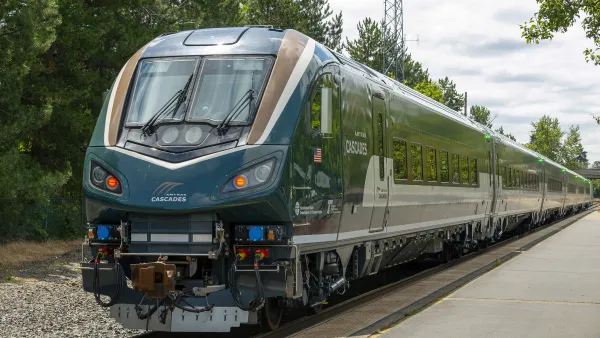
Northwest rail fans eager for Sept. 30 debut of Amtrak’s Airo fleet
Get ready for that new train smell and more seats. But they won’t go faster or run more frequently on the Cascades route in Washington and Oregon.
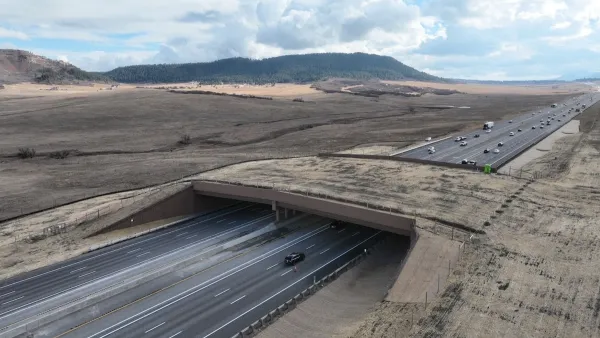
Record-breaking wildlife overpass in Colorado brings 91% reduction in animal collisions
Prior to the overpass, vehicles were hitting one deer per day on Colorado’s Interstate 25.

Detroit to transform waterfront with $2.2 billion investment
Developers will convert about 18 acres of unused parking lot space into civic spaces.

‘Going backwards:’ Baltimore mayor, students rally against state's transit funding plan
Maryland's proposed six-year plan provides no funding for Baltimore’s BMORE bus program and reduces its road maintenance funding.

Trump wants to cancel nearly 98% of funding for HUD housing support program
Multiple housing groups are suing the administration in an effort to preserve the funding.

FREE Course: Walkable City 1: Why Walkability?
After describing his path towards focusing on walkability as the essence of good planning, Jeff Speck marches through his five principal reasons for making more walkable places.
Reinventing Malls: Planning Alchemy—Turning Gray Fields Into Gold
The course focuses on the opportunities and imperatives that shape reinvention of mall sites.

City of Thousand Oaks
City of Wisconsin Rapids
Harvard University Graduate School of Design
The Architects Foundation
University of Cincinnati Online
Northern Illinois Transit Authority (NITA)
The Pocatello Development Authority
The Urban Renewal Agency of the City of Pocatello

