Nick Paumgarten imagines a New York City landscape that would result from a present-day economic crisis.


"In the mind's eye, we tend to populate our recessionary streets with squad cars painted green, cat's-eyed ambulances, and other anachronisms-'Fort Apache, the Bronx: The Remake.' But, really, the city will probably just look the way it does now. After an extraordinary era of construction and renovation, demolition and replacement, there will almost certainly come a long period in which little to nothing gets built. Putting aside the long-discussed public projects that are endangered or doomed (the Second Avenue Subway, the West Side Railyards, Brooklyn Bridge Park, Moynihan Station, etc.), dozens of private undertakings have stalled or died. The calls go out to the architects: pencils down. We have inherited, from the good years, a glut of housing, almost all of it of the unaffordable kind-condos galore-and an increase in office space amid a sudden, steep decrease in the need for it. Throw in the high cost, or total unavailability, of capital, owing to the credit freeze, and you have a New York that may be frozen in time. The skyline, which has been very dynamic recently, like a stereo's equalizer display, should sit still for a while. The clothes in our closets today will be the ones we're wearing when we're old."
Read the full story: The Pits

Recession Hurting Transit Agencies Across U.S.
Big metropolitan transit agencies are struggling through the recession, with many considering cutting services and raising fares, according to astudy by Transportation For America and Transportation Equity Network.
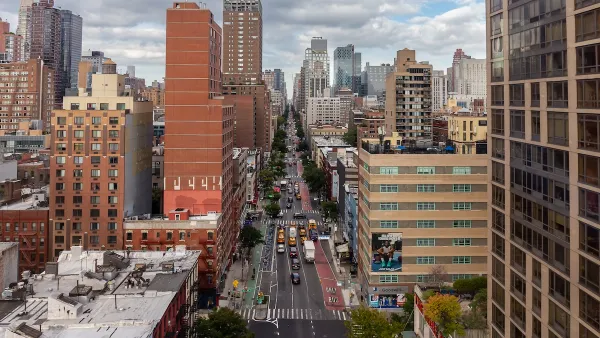
See the 12 communities on New York City’s affordable housing naughty list
The Upper East and West Sides, Elmhurst, and Bayside are among the communities that have built little affordable housing over the past five years, and now will see certain projects fast-tracked under new city rules.
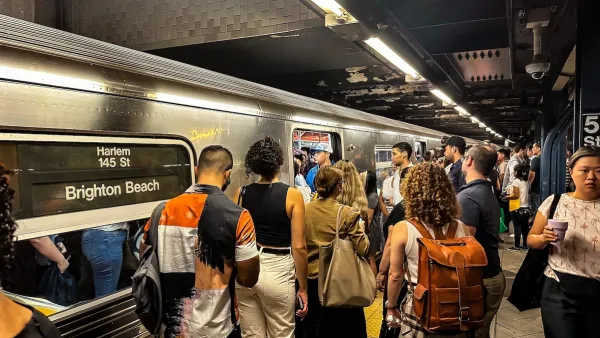
MTA expects Trump’s tariffs to increase new NYC transit costs by $1 billion
The Metropolitan Transit Authority said the cost of new subway cars has risen by 30% since Trump began his second term as president.

Planetizen Federal Action Tracker
A weekly monitor of how Trump’s orders and actions are impacting planners and planning in America.

‘Going backwards:’ Baltimore mayor, students rally against state's transit funding plan
Maryland's proposed six-year plan provides no funding for Baltimore’s BMORE bus program and reduces its road maintenance funding.
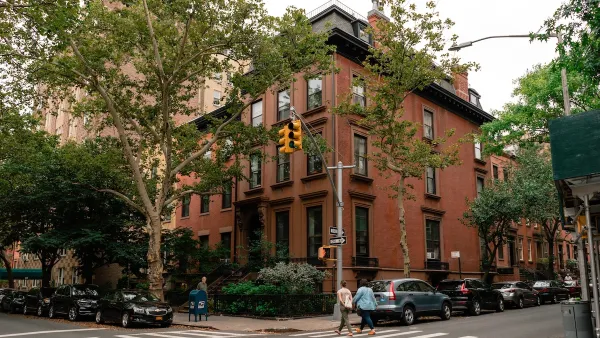
Mamdani sent nearly 6,000 pied-à-terre tax warnings to homes that didn’t qualify
A judge has ordered the administration to cancel thousands of pied-à-terre tax notices after it sent 35% of them erroneously.

Newsom vetoes high-speed rail supervision bill after agency receives condemnatory audit
The audit found the CHSRA approved almost $600,000 in unallowable travel expenses.

Nation sees first electric plane-boat hybrid take off in public demo
The Viceroy Seaglider can fly at speeds of 180mph for up to 180 miles.

One of nation’s poorest counties to receive $6 billion data center
The developers estimate the project will create 200 permanent jobs and 1,000 temporary construction jobs.

FREE Course: Walkable City 1: Why Walkability?
After describing his path towards focusing on walkability as the essence of good planning, Jeff Speck marches through his five principal reasons for making more walkable places.
Reinventing Malls: Planning Alchemy—Turning Gray Fields Into Gold
The course focuses on the opportunities and imperatives that shape reinvention of mall sites.

City of Thousand Oaks
City of Wisconsin Rapids
Harvard University Graduate School of Design
The Architects Foundation
University of Cincinnati Online
Northern Illinois Transit Authority (NITA)
The Pocatello Development Authority
The Urban Renewal Agency of the City of Pocatello