In back-to-back rulings, the Californian Air Resources Board approved the nation's strongest climate protection plan and the strictest on-road diesel emissions plans that will mean the oldest, most polluting trucks and buses will soon be no more.


"The (diesel) regulations, approved one day after the California Air Resources Board's landmark vote to curb greenhouse gases (see related article), require all trucks and buses, whether or not they are registered in the state, to retrofit or replace their rigs starting in 2010.
Truck owners would be required to install filters on their exhaust, and most would have to do so by 2014. Truckers also would have to replace their engines between 2012 and 2022 or buy a new truck with an engine made with 2010 specifications.
Air board officials estimate that the rule will save the lives of 9,400 people between 2011 and 2025.
Board member Dr. John Balmes said after the vote that while the change might cost the industry more than $5 billion (with only $1 billion in state funding assistance to offer), the savings in public health costs are estimated at as much as $50 billion.
Air board officials said their top priority is public health, adding that failure to meet clean air standards in the San Joaquin Valley and Southern California would put $2 billion in federal highway money at risk."
Read the full story: Air board adopts strict rules on diesel exhaust
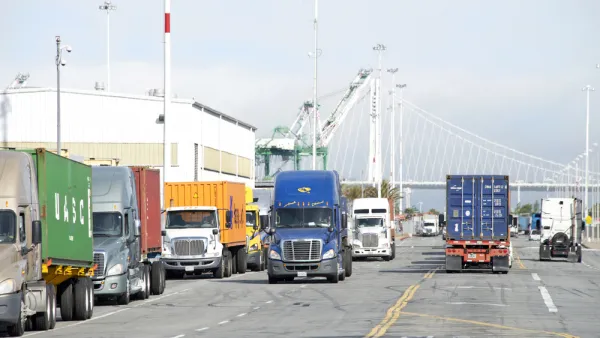
Two New California Laws Take Aim at Pollution from Heavy-Duty Trucks
Trucks, which disproportionately contribute toward air pollution, will soon be subject to similar types of smog checks that apply to light-duty vehicles. A second bill signed by Gov. Gavin Newsom will spur movement toward cleaner alternatives.

A Departing Blow to Clean Air on Pruitt's Final Day
Friday may have been disgraced EPA Administrator Scott Pruitt's last day in office of the agency in charge of protecting the nation's environment, but he still managed to roll back a regulation to create lasting air pollution far greater than VW did.

California to Invest $1 Billion in Electric Trucks, Buses, Charging Infrastructure
The investment comes not from the state legislature but from two regulatory bodies, the Air Resources Board and the Public Utilities Commission, authorizing the expenditure of VW settlement funds and utility ratepayer funds, respectively.

Planetizen Federal Action Tracker
A weekly monitor of how Trump’s orders and actions are impacting planners and planning in America.

California plans to bury El Niño’s downpour
If the state plays its cards right, it may be able to store a billion acre-feet of El Niño’s water in aquifers.

Desperate measures: Advocates weigh draining Lake Powell to fill Colorado River
Draining the reservoir could reduce evaporation losses by a couple hundred thousand acre-feet.

Chicago voters approve permanent festival grounds, penalty for vacant property owners
Currently, major summer and fall festivals take over public parks for weeks at a time, drawing criticism from nearby residents

NYC votes to cut outdoor dining red tape, speed up permitting
New York City also voted to allow the Department of Transportation to begin work on urgent projects before notifying elected officials.

California appears to reject Prop. 45
The proposition would have expanded the projects that qualify for a streamlined environmental review, effectively paring down the California Environmental Quality Act.

FREE Course: Walkable City 1: Why Walkability?
After describing his path towards focusing on walkability as the essence of good planning, Jeff Speck marches through his five principal reasons for making more walkable places.
Reinventing Malls: Planning Alchemy—Turning Gray Fields Into Gold
The course focuses on the opportunities and imperatives that shape reinvention of mall sites.

City of Rosemead
Rutgers University, Edward J. Bloustein School of Planning and Public Policy
One Hundred Miles
Hunter College, City University of New York (CUNY)
The Architects Foundation
University of Cincinnati Online
City of Cambridge
Montrose County
The Pocatello Development Authority