Relatively modest fair hikes, in places where fares previously did and did not exist, and a regional mobility tax are a part of the plan to rescue the Metropolitan Transportation Agency from further debt.


"The plan - presented in a 19-page report [pdf] - would permit automatic, inflation-adjusted fare and toll increases every two years without public hearings, ending what [Commission on Metropolitan Transportation Authority Financing leader Richard] Ravitch called a cyclical "political circus." The plan would allow for a state takeover of the city-owned Harlem River and East River bridges, which have historically been free to drivers. The new tolls would be collected electronically, without toll booths.
The regional mobility tax - 33 cents on every $100 of payroll - would provide $1.5 billion a year, and the tolls would produce $600 million in net revenue a year ($1 billion a year in gross revenue minus expenses), Mr. Ravitch said. The new revenue streams would help finance borrowing for a $30 billion-to-$35 billion M.T.A. capital plan for 2010 to 2014 that would help stimulate the economy while maintaining vital infrastructure.
'This is a major stimulus bill to New York State,' Mr. Ravitch said at a morning news conference at the governor's office in Midtown Manhattan. 'The number of projects being canceled and terminated as a result of inadequate financing,' he said, is 'adding enormously to all the other problems this financial crisis has imposed on everybody.'"
Read the full story: Ravitch Unveils M.T.A. Rescue Plan
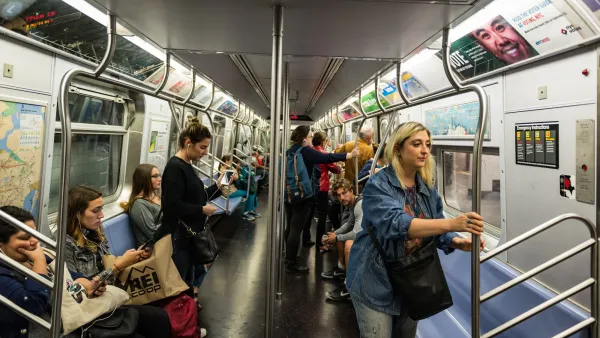
Unlocking the full potential of NYC's Interborough Express
A few strategic investments could turn the IBX into an essential spine of the regional transportation network, not just another branch of New York's subway system.
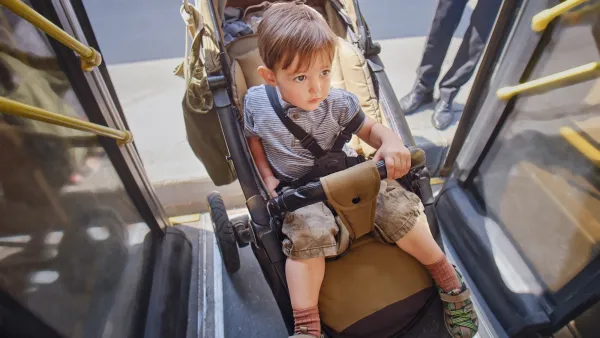
MTA plans to outfit all buses with stroller storage by next year
All buses will have seats that flip up to allow for stroller storage or more standing room.
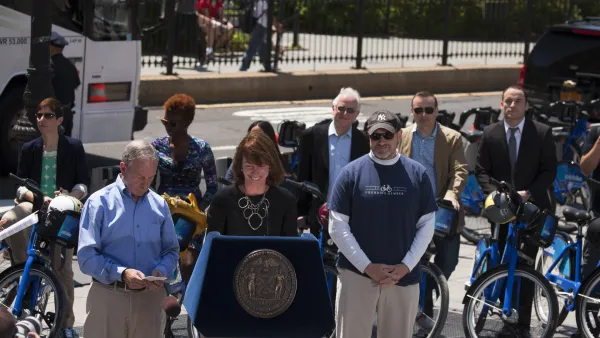
NYC 'bicycle visionary' Janette Sadik-Khan returns to public service with appointment to MTA board
The former DOT commissioner is known for her efforts to make NYC streets safe for people biking and walking.

Desperate measures: Advocates weigh draining Lake Powell to fill Colorado River
Draining the reservoir could reduce evaporation losses by a couple hundred thousand acre-feet.

Eastern Nebraska is running out of electricity
Data centers and electrification are straining eastern Nebraska’s grid, throttling economic development.

Malls are becoming the midtowns of the future
Mall and office park redevelopments are a generational opportunity to create new nodes of urbanity.

NYC breaks ground on anti-flooding infrastructure project
New York City's new system will reduce stormwater flows to local sewers by 90%.

One Kentucky town’s secret to affordable housing
The Smoketown Community Land Trust has already built seven affordable homes for community members.

Houston gains petal-shaped cooling infrastructure to make streets more ‘delightful’
The city has installed the pavilions along 15 blocks in Houston.

FREE Course: Walkable City 1: Why Walkability?
After describing his path towards focusing on walkability as the essence of good planning, Jeff Speck marches through his five principal reasons for making more walkable places.
Reinventing Malls: Planning Alchemy—Turning Gray Fields Into Gold
The course focuses on the opportunities and imperatives that shape reinvention of mall sites.

City of Rosemead
Rutgers University, Edward J. Bloustein School of Planning and Public Policy
One Hundred Miles
University of Michigan School for Environment and Sustainability (SEAS)
Hunter College, City University of New York (CUNY)
The Architects Foundation
City of Cambridge
Montrose County
The Pocatello Development Authority