In this piece from Citiwire, Jonathan D. Miller argues that infrastructure and the economy are not islands. Improving the nation's infrastructure, he says, will improve the economy.


"In fact, a retooled national infrastructure will be an essential part of the solution to maintaining our economic clout and future prosperity, while providing the needed stimulus of a near-term jobs engine."
"The challenges are huge: Our once-vaunted interstate system is overwhelmed by traffic around major gateway cities and along truck corridors. Our metro regions lack public transit systems robust enough to tame oil consumption and sustain future growth. The nation has literally zero high-speed rail lines and may need four or more major new airports. Major East and West coastal ports have turned into huge bottlenecks and our national freight shipping network needs radical upgrading. Chronic traffic jams, lost time, higher driving and logistics costs can only get worse as the U.S. population expands by an expected 100 million people between now and 2040."
Read the full story: Infrastructure, the Economy: Hello! — They’re Linked!

The Historical Effect of Pandemics on the Economy and the Housing Market
Research into previous pandemics, like SARS in 2003, the Spanish Flu in 1918, and the early months of COVID-19 in China, offers insight into what to expect for the economy and the housing market during and after the current pandemic.
The Architecture Billings Index Was Strong on the Eve of the Pandemic
The Architecture Billings Index in February 2020 could lend hope in the current economic climate, or it could set a benchmark for a future recovery.
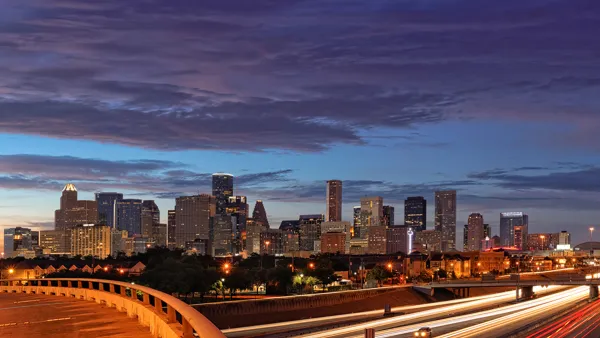
Changes in Houston Over the Last Decade
Comparing Houston in 2010 to the city today reveals a variety of transportation, infrastructure, and economic changes.

Planetizen Federal Action Tracker
A weekly monitor of how Trump’s orders and actions are impacting planners and planning in America.

California plans to bury El Niño’s downpour
If the state plays its cards right, it may be able to store a billion acre-feet of El Niño’s water in aquifers.

Desperate measures: Advocates weigh draining Lake Powell to fill Colorado River
Draining the reservoir could reduce evaporation losses by a couple hundred thousand acre-feet.

Mamdani’s pied-à-terre tax survives legal challenge
A panel of judges found that the plaintiffs failed to demonstrate injury as a result of New York City's implementation of the tax.

Eastern Nebraska is running out of electricity
Data centers and electrification are straining eastern Nebraska’s grid, throttling economic development.

Seattle passes record-breaking transit services expansion
Proposition 1 will double the city’s transit tax to add 95,000 more bus trips and preserve 180,000 bus trips annually.

FREE Course: Walkable City 1: Why Walkability?
After describing his path towards focusing on walkability as the essence of good planning, Jeff Speck marches through his five principal reasons for making more walkable places.
Reinventing Malls: Planning Alchemy—Turning Gray Fields Into Gold
The course focuses on the opportunities and imperatives that shape reinvention of mall sites.

City of Rosemead
Rutgers University, Edward J. Bloustein School of Planning and Public Policy
One Hundred Miles
University of Michigan School for Environment and Sustainability (SEAS)
Hunter College, City University of New York (CUNY)
The Architects Foundation
City of Cambridge
Montrose County
The Pocatello Development Authority