

























After a New York Times article revealed an 'epidemic' of disability claims for retired employees of the Long Island Rail Road (the nation's largest commuter railroad), NY Governor Paterson announced he would have AG Cuomo launch an investigation.


N.Y. "Gov. David A. Paterson said on Sunday (9/21) that he would give Andrew M. Cuomo, the state's attorney general, broad powers... to investigate how disability and pension benefits were potentially manipulated by L.I.R.R. supervisors, workers and retirees.
The governor's action comes after The New York Times reported that virtually every career employee of the railroad applies for and gets disability payments soon after retirement at a cost of hundreds of millions of dollars in federal disability money. The disability claims are paid by an obscure federal agency called the Railroad Retirement Board.
A senior state official said that the governor would also ask Congress and the United States attorney general to review the role played by the Railroad Retirement Board, which almost never says no to disability claims."
The high rate of disability pensions awarded to former L.I.R.R. employees by this governmental body is alarming and out of sync with our workplace safety record, the (L.I.R.R.) said.
_________________________________________________________________________
From NYT: "A Disability Epidemic Among a Railroad's Retirees", 9/21:
"Virtually every career employee - as many as 97 percent in one recent year - applies for and gets disability payments soon after retirement, a computer analysis of federal records by The New York Times has found.
At an age when most people still work, they get a pension and tens of thousands of dollars in annual disability payments - a sum roughly equal to the base salary of their old jobs.
With incentives like these, occupational disabilities at the L.I.R.R. have become a full-blown epidemic."
Thanks to Mark Boshnack
FULL STORY: Paterson Seeks Study of Benefits at L.I.R.R


Making Mobility More Inclusive
A new study highlights the challenges people with disabilities continue to face in navigating urban spaces.

Designing for Dementia
Proponents of 'dementia design' call for inclusive design that centers the experience of people living with dementia and other disabilities that impact how they experience the urban environment.

Biden Administration Targets Five States that Ban School Mask Mandates
President Biden asked his education secretary to see what could be done about states that prohibit school districts from enacting CDC public health recommendations. Miguel Cardona responded by empowering his Office of Civil Rights to investigate.

Planetizen Federal Action Tracker
A weekly monitor of how Trump’s orders and actions are impacting planners and planning in America.

Maui's Vacation Rental Debate Turns Ugly
Verbal attacks, misinformation campaigns and fistfights plague a high-stakes debate to convert thousands of vacation rentals into long-term housing.
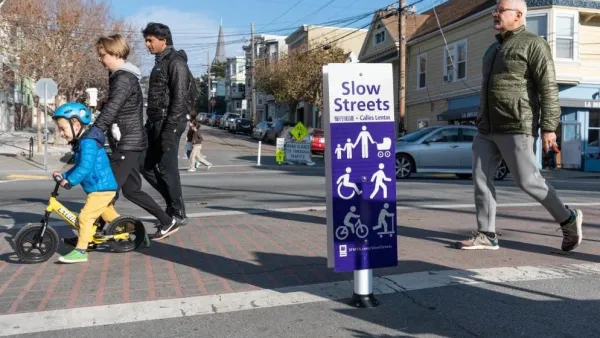
San Francisco Suspends Traffic Calming Amidst Record Deaths
Citing “a challenging fiscal landscape,” the city will cease the program on the heels of 42 traffic deaths, including 24 pedestrians.

Amtrak Rolls Out New Orleans to Alabama “Mardi Gras” Train
The new service will operate morning and evening departures between Mobile and New Orleans.

The Subversive Car-Free Guide to Trump's Great American Road Trip
Car-free ways to access Chicagoland’s best tourist attractions.

San Antonio and Austin are Fusing Into one Massive Megaregion
The region spanning the two central Texas cities is growing fast, posing challenges for local infrastructure and water supplies.

Urban Design for Planners 1: Software Tools
This six-course series explores essential urban design concepts using open source software and equips planners with the tools they need to participate fully in the urban design process.
Planning for Universal Design
Learn the tools for implementing Universal Design in planning regulations.

Heyer Gruel & Associates PA
JM Goldson LLC
Custer County Colorado
City of Camden Redevelopment Agency
City of Astoria
Transportation Research & Education Center (TREC) at Portland State University
Jefferson Parish Government
Camden Redevelopment Agency
City of Claremont