China is rapidly becoming home to more and more mega-cities, and there's little sign of it slowing down.


"The mega-city -- usually defined as a city with a population of 10 million or more -- isn't a new phenomenon, or one that China invented. Yet urbanists are looking to China (where Shanghai and Beijing are already mega-cities, and at least a dozen others are huge, if not "mega") to find the capital of the 21st century, rather like Paris was the capital of the 19th, and New York the capital of the 20th. And these urbanists (the profession that studies urban trends and design with varying degrees of academic legitimacy) are fascinated by Chinese cities, horrified by them, desperate to steer them away from environmental disaster and growing social anomie. Animating all this concern is a basic fact: The Chinese mega city isn't there yet. It is still growing. A migration unlike anything the world has ever seen is in progress, with hundreds of millions of rural Chinese flocking to cities."
"The statistics are overwhelming. If China continues to urbanize, if it reaches levels comparable to the United States (around 80 percent urban), there could be a billion people living in its cities sometime in the not-so-distant future. Conservative, near-term estimates suggest that 200 million to 300 million people will leave traditional rural and village life for the economic opportunities of China's exploding urban areas over the next two decades."
Read the full story: Sizing Up a Mega-City

Coronavirus Effects on the Global Transportation System
As the coronavirus continues to move across the globe, its effects on shared transportation modes and freight shipping are becoming more apparent.

Buildings Full of Empty Apartments Pose Problems in China
Failed investments and buildings with no tenants sit on the outskirts of Beijing and Shanghai.
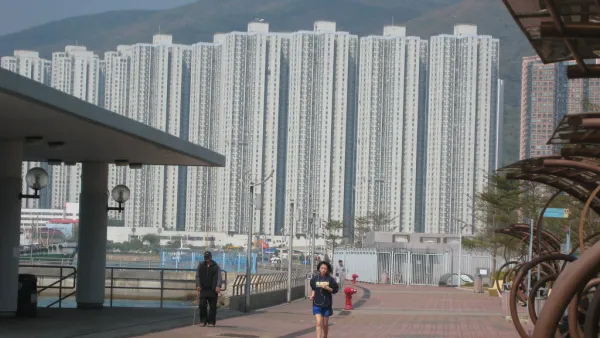
Asian, Australian Property Markets Begin to Cool
Markets for residential property income of East Asia's most expensive cities are slowing down. The U.S.-China trade war is one factor, along with local controls and a mainland Chinese economy applying the brakes.

Planetizen Federal Action Tracker
A weekly monitor of how Trump’s orders and actions are impacting planners and planning in America.

Amtrak, CN end decades-long dispute with eight-year agreement
The new operating agreement establishes an updated framework for the companies to work together, including processes to resolve disputes.

Judges permit Denver to divert 77,000 acre feet from the Colorado River for reservoir expansion
Overuse and climate change have caused the Colorado River’s water levels to plummet.

NYC DOT wants faster, more permanent street upgrades
The city is examining ways to build more concrete infrastructure without getting entangled in 'decades-long' projects.

'Something we’ve never seen before:' rising utility rates could strain city finances nationwide
Data centers, climate change and other factors have caused utility rates in the United States to increase by 38% since 2020.

Trump to overrule local leaders, lease millions of acres of America’s Pacific Island territories’ seafloors to mining companies
International law says that the Indigenous people of America’s territories have a right to prior and informed consent regarding projects that impact their countries.

FREE Course: Walkable City 1: Why Walkability?
After describing his path towards focusing on walkability as the essence of good planning, Jeff Speck marches through his five principal reasons for making more walkable places.
Reinventing Malls: Planning Alchemy—Turning Gray Fields Into Gold
The course focuses on the opportunities and imperatives that shape reinvention of mall sites.

Harvard University Graduate School of Design
KFH Group Inc.
Greater Baltimore Committee
The Architects Foundation
University of Cincinnati Online
The Pocatello Development Authority
The Urban Renewal Agency of the City of Pocatello