In an effort to raise extra money, cities and counties in Florida have been selling advertising in public spaces. Some say it's a good way to get extra revenue, but others worry about the visual pollution of public areas.


"As many local governments in Florida slash budgets to compensate for declining property tax revenues, a few are trying to raise money by selling public space for environmentally-focused advertisements that look like road signs."
"The ad revenues pay for environmental projects."
"Sarasota County environmental experts are evaluating the program to see if it would work locally. The money would help during tight budget times when environmental projects often take a back seat to core government services."
"But it could promote clutter along public roadways and facilitate "green washing," a term for polishing the credentials of a company with questionable environmental values."
"The program also raises questions about how much advertising is appropriate on public property."
Read the full story: Eco-ads offer cash for public space
New Train Tunnel Ads Irk Riders, Draw Revenue
Flashing lights on the walls on train tunnels that display a 15-second video to passengers have been introduced in L.A., bringing new revenue to the area's transit agency, but bothering some riders. Some say the ads intrude on public space.
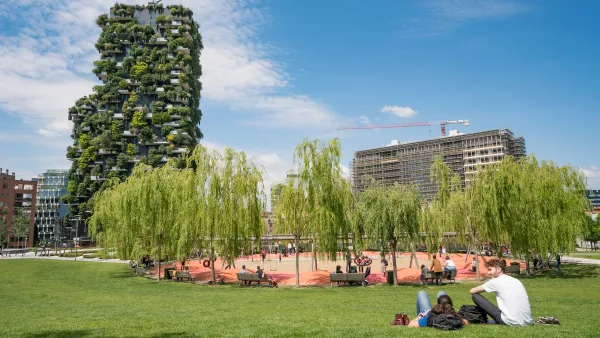
Planning for Love, Part 1: The link between urban form and dating
A brief exploration of dating through history highlights how the spaces in which we live and move shape our social lives and relationships.
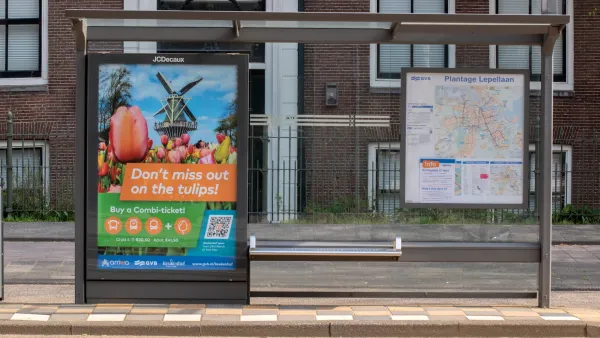
Amsterdam is First World Capital to Ban Ads for Fossil Fuels on Public Infrastructure
Several other Dutch cities have banned advertising for harmful or polluting industries on city-owned properties.

Desperate measures: Advocates weigh draining Lake Powell to fill Colorado River
Draining the reservoir could reduce evaporation losses by a couple hundred thousand acre-feet.

Eastern Nebraska is running out of electricity
Data centers and electrification are straining eastern Nebraska’s grid, throttling economic development.

Move over, LA: St. Louis gears up for Olympics, invests millions in downtown redevelopment
The Missouri city will host the 2028 Olympic soccer group stage and knockout matches.

Mass. votes against statewide minimum lot size for single-family homes
Over 2 million residents voted on Question 7; it was decided by just over 30,000 votes.

Maryland’s $15 billion bridge project gains key approval
The Maryland Transit Authority said the project will create over 60,000 jobs and add $23 billion to the local economy.

‘No clear next steps’ for Chicago's permanent festival grounds
Eleventh Ward Ald. Nicole Lee has suggested Soldier Field as a possible location for the permanent event space.

FREE Course: Walkable City 1: Why Walkability?
After describing his path towards focusing on walkability as the essence of good planning, Jeff Speck marches through his five principal reasons for making more walkable places.
Reinventing Malls: Planning Alchemy—Turning Gray Fields Into Gold
The course focuses on the opportunities and imperatives that shape reinvention of mall sites.

City of Rosemead
Rutgers University, Edward J. Bloustein School of Planning and Public Policy
One Hundred Miles
University of Michigan School for Environment and Sustainability (SEAS)
Hunter College, City University of New York (CUNY)
The Architects Foundation
City of Cambridge
Montrose County
The Pocatello Development Authority