Toronto's Metrolink brings together city and transportation planners to brainstorm the transit of the future.


"Any transportation system in the future has to be user friendly, seamless and add value because somebody has to pay for it and the public sector won't be able to pay for all of it, said George Hazel, a British transportation planning expert.
Connectivity is key, he said. "How do you join up the buses to the transit, to the parking, to cycling, to walking because there are discontinuities all over the place," he said. "In Singapore, you can get into a taxi and there's a swipe (machine) behind the driver's head. You can use your transit card in a taxi."
Some of yesterday's ideas are pie in the sky, "But we have to be creative," said Al Robinson, GO Transit's director of equipment development, who was part of a brainstorming team rethinking the interiors of transit vehicles.
Among the suggestions: A quiet car equipped with laptops, wireless Internet access and reclining chairs so people who wanted to sleep or work could do so in comfort."
Read the full story: Planners dream big for future of transit

Robert Reich Stumps for Transit
Former Secretary of Labor Robert Reich gives his two cents about the need to expand public transit.

Brightline West Moves Forward With Finalized Federal Funding
The high-speed rail line will connect Southern California and Las Vegas via a two-hour trip along Interstate 15.

Austin’s Project Connect Gains Key Budget Approval
The light rail project can move forward with the engineering and design phase, with a groundbreaking expected in 2027.

Planetizen Federal Action Tracker
A weekly monitor of how Trump’s orders and actions are impacting planners and planning in America.

Chicago breaks ground on $3 billion megadevelopment
The new neighborhood, titled Foundry Park, will one day host 3,700 residences.
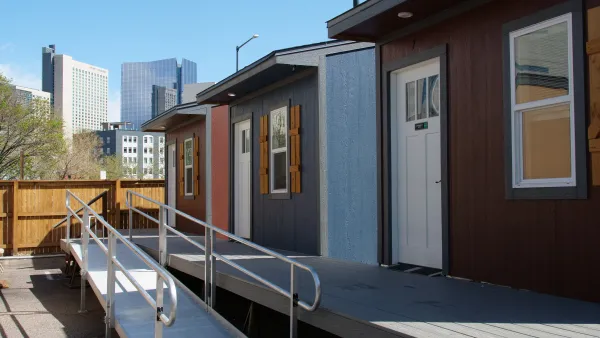
Denver is solving homelessness. Why aren't the rest of us?
Since 2023, Denver's street homeless population has decreased by 64%, proving that effective tools exist to support those in need of housing.

LA accused of breaching $1.4 billion sidewalk repair settlement
The city faces a backlog of nearly 5,000 street repair requests.

MTA kicks off six-year, $1 billion transit upgrade project
The authority is replacing the roughly 90-year-old train signals on the A and C line with modern technology.

Developers may expand largest gas pipeline network in Northwest
Pipeline giant Williams has proposed new expansions for its Northwest Pipeline from the Colorado Rockies through Idaho, Oregon and Washington.

FREE Course: Walkable City 1: Why Walkability?
After describing his path towards focusing on walkability as the essence of good planning, Jeff Speck marches through his five principal reasons for making more walkable places.
Reinventing Malls: Planning Alchemy—Turning Gray Fields Into Gold
The course focuses on the opportunities and imperatives that shape reinvention of mall sites.

City of Rosemead
Rutgers University, Edward J. Bloustein School of Planning and Public Policy
One Hundred Miles
The Architects Foundation
University of Cincinnati Online
Montrose County
Northern Illinois Transit Authority (NITA)
The Pocatello Development Authority