Transportation planners and public officials have begun to consider ways to reconfigure cities and alter driving patterns in order to reduce vehicle miles traveled and reduce greenhouse gas emissions.


"A furious, though still fledgling, effort has commenced to help America's drivers curtail their trips, burn less fuel and, ultimately, emit less CO2. It involves a marriage of transportation planning, land use planning, engineering and public policy to implement everything from smart growth to congestion pricing to increased use of mass transit. And if that wasn't complicated enough, it will involve every level of government, from town hall to the United Nations."
"Transportation planners used to strive for less congestion or faster flows, but overall traffic volume was a fact of life. Now the focus is shifting into reverse. '[Transportation planning] has to be very important [in reducing CO2],' former Clinton administration Energy Secretary Bill Richardson told InTransition. 'You can't have a planet without energy-efficient transportation systems that emphasize commuter rail, light rail, open space and land use policies that protect quality of life.'"
"At more intimate scales, local land use and transportation planning may take a page from urban planning, in which efforts to promote infill, mixed-use, TOD and walkable, bikeable development have long been underway. It is hoped this sort of development would compel residents to walk rather than drive and focus their attention on their immediate communities, whose charms will make freeway trips and gridlock less appealing."
Read the full story: Transportation Planning Warms Up To Climate Change

Time to Adapt to a Warmer World is Now
Public officials and scientists are starting to say that adaptation to climate change is just as important as trying to stem climate change. One way to adapt is to embrace smart growth principles that reduce energy usage, according to this article.
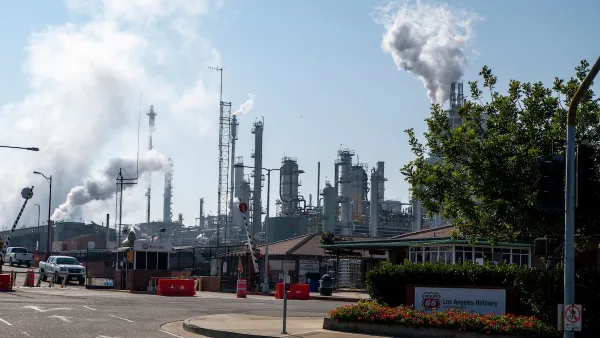
California’s Cap and Trade Program Up in the Air
The state’s carbon trading program is being attacked as ineffective from one side and overly onerous from the other.
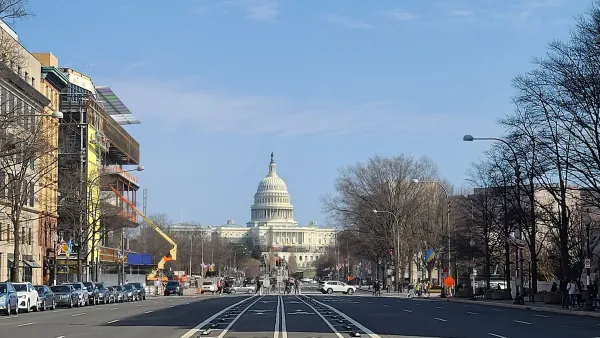
Planning Trends for 2025: Creative Housing Solutions, Ongoing Transit Woes, and the Ever-Creeping Tentacles of AI
Urban planners have no shortage of urgent issues to delve into, from a deepening housing crisis to an increasingly unpredictable climate to a new federal administration bent on slashing key funding for everything from electric cars to housing assistance.

Planetizen Federal Action Tracker
A weekly monitor of how Trump’s orders and actions are impacting planners and planning in America.

Northwest rail fans eager for Sept. 30 debut of Amtrak’s Airo fleet
Get ready for that new train smell and more seats. But they won’t go faster or run more frequently on the Cascades route in Washington and Oregon.
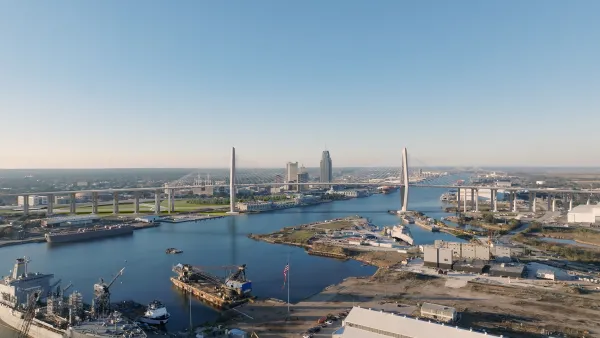
Alabama scores up to $2.5 billion federal loan for largest infrastructure project in state’s history
The Mobile River Bridge and Bayway Project aims to ease congestion at Alabama’s worst bottleneck.

Novel study finds extreme state-by-state disparity in housing construction timelines
The first comprehensive working paper on U.S. construction timelines also found that the permitting process for multi-family projects has slowed nationwide.

California may destroy its beaches trying to save homes from El Niño
Boulders and seawalls can protect homes from waves, but ultimately destroy sandy beaches.

California high-speed rail accomplishes only one legislative goal in 2026
The majority of the agency's failed pitches were never developed into written proposals.

FREE Course: Walkable City 1: Why Walkability?
After describing his path towards focusing on walkability as the essence of good planning, Jeff Speck marches through his five principal reasons for making more walkable places.
Reinventing Malls: Planning Alchemy—Turning Gray Fields Into Gold
The course focuses on the opportunities and imperatives that shape reinvention of mall sites.

City of Thousand Oaks
City of Wisconsin Rapids
Harvard University Graduate School of Design
The Architects Foundation
University of Cincinnati Online
Northern Illinois Transit Authority (NITA)
The Pocatello Development Authority
The Urban Renewal Agency of the City of Pocatello