The San Francisco County Transportation Authority is working on two applications of congestion pricing for the city's downtown core and on a major road leading to the Golden Gate Bridge.


"Details of the congestion pricing initiatives under consideration in San Francisco have yet to be worked out.
But the goal is twofold: Reduce congestion by discouraging drivers from getting into their polluting cars and raise money for transit. City officials say Muni, for example, needs an extra $100 million a year to make significant service improvements. The money could also help promote biking and make streets safer for pedestrians."
"In addition to the grant for Doyle Drive, the federal government gave the city $1 million to study driving fees in San Francisco, particularly the downtown core and major arteries to and from the Bay Bridge."
"In San Francisco, the program could make use of the FasTrak electronic toll-collecting system," as opposed to utilizing the London technology, where "cameras snap photos of license plates, and drivers must pay the charge either before or on the day of travel. Such logistics have yet to be decided. The amount of the fee and how it would fluctuate according to the time or day and location also are unclear."
"On more than 60 percent of downtown streets, the average speed is less than 10 mph, according to local transportation planners, and the problem is expected to get worse with projected job growth and residential development over the next 25 years."
Both downtown cordon pricing and Doyle Drive projects need approval from city and state legislators.
"We think it's something that at least deserves consideration," said Tilly Chang, the San Francisco County Transportation Authority's deputy director for planning. "We wouldn't be looking at it if we didn't think it showed promise."
"The transportation authority's recommendations on fees are expected next summer."
"San Francisco Supervisor Jake McGoldrick, who chairs the San Francisco County Transportation Authority, said congestion pricing is a way to manage traffic and help fund transit. The idea fits well into San Francisco's "transit first" policy that tries to give high priority to the use of public transportation."
Thanks to Jennifer Alverson
Read the full story: S.F. studying congestion pricing to ease traffic, promote transit


Planetizen Federal Action Tracker
A weekly monitor of how Trump’s orders and actions are impacting planners and planning in America.

Data reveals that NYC’s bet on congestion pricing has paid off
After almost two years of the program, reports show positive impacts on traffic and air quality and no disruptions to parking.
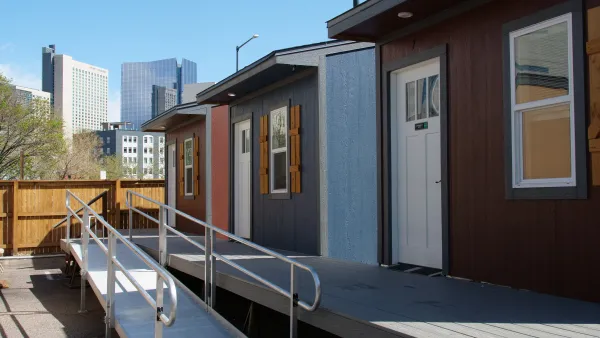
Denver is solving homelessness. Why aren't the rest of us?
Since 2023, Denver's street homeless population has decreased by 64%, proving that effective tools exist to support those in need of housing.

CA city to shut down airport, transform it into utopian park
The western side of the 200-acre park will feature a dog park, nature education center and arboretum.

NYC to vote on supporting outdoor dining, streamlining bus and bike lane creation
The city has five proposed amendments to its municipal constitution on the ballot this November.

Chicago breaks ground on $3 billion megadevelopment
The new neighborhood, titled Foundry Park, will one day host 3,700 residences.

FREE Course: Walkable City 1: Why Walkability?
After describing his path towards focusing on walkability as the essence of good planning, Jeff Speck marches through his five principal reasons for making more walkable places.
Reinventing Malls: Planning Alchemy—Turning Gray Fields Into Gold
The course focuses on the opportunities and imperatives that shape reinvention of mall sites.

City of Rosemead
Rutgers University, Edward J. Bloustein School of Planning and Public Policy
One Hundred Miles
The Architects Foundation
University of Cincinnati Online
Montrose County
Northern Illinois Transit Authority (NITA)
The Pocatello Development Authority