Ed Uhlir details the development and maintenance of one of America's most successful urban parks.


"The planning of the park developed from a very safe initial plan, which was an extension of the formal French Renaissance plan of Grant Park, into a plan of many visions of many architects, landscape architects, and artists, rather than a single vision. It has a variety of things to bring people together. Its public spaces are more interactive than any other public park in the country. It has unique programming, which we expand every summer. We're trying to do programming all year now. And I think it's the one space in Chicago that belongs to everyone; it's the most democratic public forum in Chicago."
"We gave a chance to Chicago benefactors and philanthropists to contribute. As the park developed and the plans developed, we were able to demonstrate that this park would be special-an opportunity for people to make a contribution that their families could see for hundreds of years in the future. Chicago has a history of civic entrepreneurship and is very fortunate in that way; other cities are trying to figure out how we did it."
Thanks to James Brasuell
Read the full story: Chicago’s Millennium Park Sets the Bar High For Los Angeles
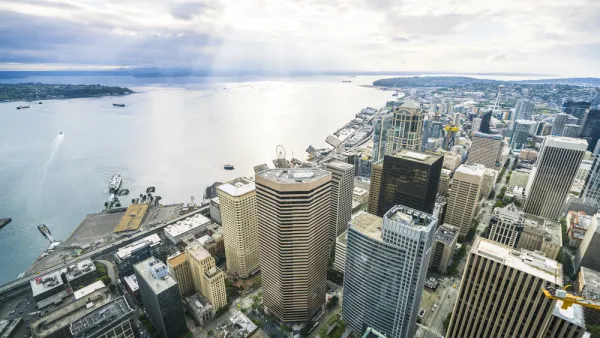
Seattle Tackling Equity Challenges With Global Lens
Seattle is faced with an affordable housing crisis that has led the new Planning & Community Development Director Sam Assefa to look globally for solutions.
Celebrating Millennium Park's 10th Anniversary with Esoteric Trivia
Millennium Park in Chicago had its grand opening on July 16, 2004. Now, ten years later, it's one of the country's most treasured, visited, and photographed public spaces.
Reviews and Reflections on the Best New Urban Parks
The New Republic offers a look and review of some of the nation's best new urban parks.

Planetizen Federal Action Tracker
A weekly monitor of how Trump’s orders and actions are impacting planners and planning in America.

Washington state to charge fee to drivers with fuel-efficient cars
Revenue from the fee will go towards supporting the state’s highways.

Illinois considers spending $1 billion in taxpayer money on data center
A quantum computing campus and data center are currently under construction in Chicago.

People Mover delayed again, LAX and contractor trade barbs
The automated train was last slated to open in January 2027.

Trump to blast ‘hydrocarbon highway’ through ‘world’s longest art gallery’
Environmental and historic preservation groups are suing to stop the project.

25 states cast bids to be the home of U.S. Space Academy
The academy will train scientists, officers and astronauts for the U.S. Space Force.

FREE Course: Walkable City 1: Why Walkability?
After describing his path towards focusing on walkability as the essence of good planning, Jeff Speck marches through his five principal reasons for making more walkable places.
Reinventing Malls: Planning Alchemy—Turning Gray Fields Into Gold
The course focuses on the opportunities and imperatives that shape reinvention of mall sites.

City of Charlotte
City of Rosemead
Rutgers University, Edward J. Bloustein School of Planning and Public Policy
University of Michigan School for Environment and Sustainability (SEAS)
Hunter College, City University of New York (CUNY)
The Architects Foundation
University District Partnership