Rather than advocate for population growth, the gritty industrial city of Youngstown, Ohio, has launched a bold plan to -- among other strategies -- let declining neighborhoods empty out and be converted to greenspace.


"Youngstown, a former steel-producing hub, has been losing residents for years as a result of the closing of most of its steel mills. But rather than struggle to regain its former glory or population, it has adopted an economic-development plan that boils down to controlled shrinkage. By accepting the inevitable, the city says it can reduce its housing stock, infrastructure and services accordingly."
Neighborhoods that are "emptying out" will eventually be converted to greenspace through mass demolitoin of decaying housing and commercial structures. "The city estimates it will take about four years to bulldoze the biggest eyesores, including about 1,000 abandoned homes and several hundred old stores, schools and other structures."
"Accepting that a city is going to shrink goes against conventional wisdom that a bigger city means more jobs, more taxpayers, more revenue, better education, and better services -- in essence, a higher standard of living. The approach is controversial. Encouraging and accepting the hollowing out of neighborhoods will, by default and design, hit Youngstown's poor and minority residents the hardest."
"Youngstown, which has lost half its population since the 1950s, says it needs a radically different approach to halt decay. It's pointless to try to revive certain neighborhoods, the city's leaders argue, since the exodus of residents often makes those areas unpleasant and dangerous places to live, leading to further decline."
"Although Youngstown is one of the first cities to openly embrace this philosophy, the idea of planning to get smaller is gaining consideration around the world...In parts of eastern Germany, the government has earmarked some $3.4 billion for tearing down communist-era prefabricated apartment blocks and replacing them with green space, partly in response to an exodus of residents to the West."
"European cities are more experienced with the phenomenon of shrinking urban centers, having endured centuries of war and famine that caused many of the region's great cities to fluctuate in size over time. A Berlin-based 'Shrinking Cities' project, partly funded by the German government, compiles research about urban-population loss."
[Editor's note: Although this article is only available to WSJ subscribers, it is available to Planetizen readers for free through the link below for a period of seven days.]
Read the full story: As Its Population Declines, Youngstown Thinks Small


Planetizen Federal Action Tracker
A weekly monitor of how Trump’s orders and actions are impacting planners and planning in America.

Northwest rail fans eager for Sept. 30 debut of Amtrak’s Airo fleet
Get ready for that new train smell and more seats. But they won’t go faster or run more frequently on the Cascades route in Washington and Oregon.
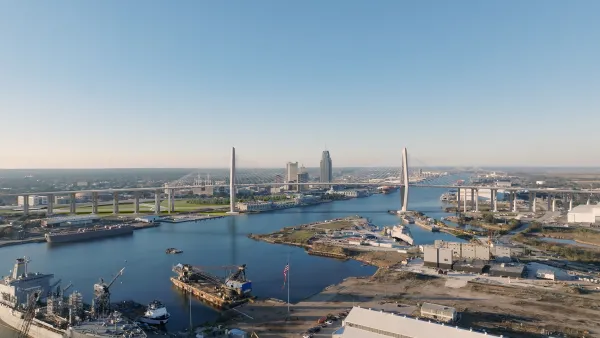
Alabama scores up to $2.5 billion federal loan for largest infrastructure project in state’s history
The Mobile River Bridge and Bayway Project aims to ease congestion at Alabama’s worst bottleneck.

Novel study finds extreme state-by-state disparity in housing construction timelines
The first comprehensive working paper on U.S. construction timelines also found that the permitting process for multi-family projects has slowed nationwide.

California may destroy its beaches trying to save homes from El Niño
Boulders and seawalls can protect homes from waves, but ultimately destroy sandy beaches.

California high-speed rail accomplishes only one legislative goal in 2026
The majority of the agency's failed pitches were never developed into written proposals.

FREE Course: Walkable City 1: Why Walkability?
After describing his path towards focusing on walkability as the essence of good planning, Jeff Speck marches through his five principal reasons for making more walkable places.
Reinventing Malls: Planning Alchemy—Turning Gray Fields Into Gold
The course focuses on the opportunities and imperatives that shape reinvention of mall sites.

City of Thousand Oaks
City of Wisconsin Rapids
Harvard University Graduate School of Design
The Architects Foundation
University of Cincinnati Online
Northern Illinois Transit Authority (NITA)
The Pocatello Development Authority
The Urban Renewal Agency of the City of Pocatello