A reports suggests that U.S. has reached a point whereby mobility trends, socio-demographic conditions and travel behavior will result in changes to annual "vehicle miles of travel" (VMT) growth.


"This report explores the major factors that influence travel behavior. The indirect factors are discussed first using primarily empirical data. These are divided into three major categories: socio-economic conditions, land use conditions, and transportation system conditions. This report concentrates most on the role of the socio-economic conditions and travel behavior followed by a discussion of the direct factors. Several of these factors appear to be undergoing historic trend reversals. In addition, new evidence suggests that congestion levels have reached the point where average travel speeds are declining. This declining speed may provide additional dampening of VMT growth."
[PDF, 49 pages, 315 KB]
Thanks to Jon Cecil, AICP
Read the full story: The Case for Moderate Growth in Vehicle Miles Traveled: A Critical Juncture in U.S. Trvavel Behavior Trends

Planetizen Federal Action Tracker
A weekly monitor of how Trump’s orders and actions are impacting planners and planning in America.

Eastern Nebraska is running out of electricity
Data centers and electrification are straining eastern Nebraska’s grid, throttling economic development.
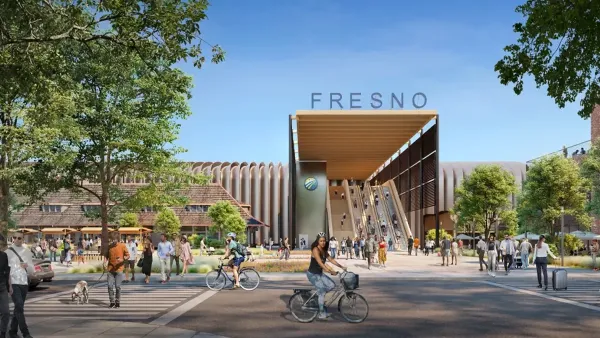
California High-Speed Rail Authority picks trainset manufacturer
The California High-Speed Rail Authority aims to start servicing passengers by 2033.

Massachusetts bogs generate both power, and cranberries
Putting solar panels above farmland is one way Massachusetts is advancing toward its goal of net-zero carbon emissions by 2050.

What could the future of LA transit look like under Raman?
The mayor-elect views broken sidewalks and potholes as crises that can be fixed with better governance.

States are counting on battery farms. Some towns don’t want them.
While fire safety has improved, some communities are still wary.

FREE Course: Walkable City 1: Why Walkability?
After describing his path towards focusing on walkability as the essence of good planning, Jeff Speck marches through his five principal reasons for making more walkable places.
Reinventing Malls: Planning Alchemy—Turning Gray Fields Into Gold
The course focuses on the opportunities and imperatives that shape reinvention of mall sites.

City of Rosemead
Rutgers University, Edward J. Bloustein School of Planning and Public Policy
One Hundred Miles
University of Michigan School for Environment and Sustainability (SEAS)
Hunter College, City University of New York (CUNY)
The Architects Foundation
City of Cambridge
The Pocatello Development Authority
The Urban Renewal Agency of the City of Pocatello