PATH
On Isolated Transit Systems
In cities like New York where multiple transit operators serve the same travelers, nothing compels those operators to work together. This isolation can result in embarrassing inefficiencies.
If You Build It, They Will Come, Says Harrison NJ Mayor
“After 15 years, his vision to transform this long-forsaken industrial town into a bedroom community for single, young professionals is finally taking shape,” writes Ronda Kaysen. Hopes for redevelopment center on the town’s commuter rail station.
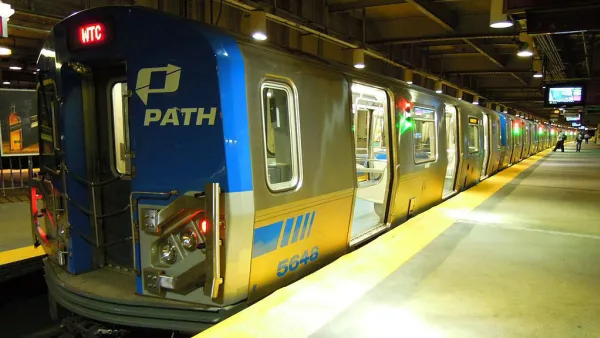
New Rail Cars On The Right PATH
You probably already know that the largest mass transit system in North America is in New York City. Perhaps you didn’t know that this system is supplemented by a very heavily used sister-system between New York City and New Jersey called the Port Authority Trans-Hudson, or PATH for short. PATH runs two lines through Jersey City, Newark, and Hoboken, carrying tens of thousands of passengers daily. My hometown, Hoboken, is considered one of the most densely populated cities in the country, and a large number of those residents commute via PATH on a daily basis. As the popularity of living in the city has increased, so have the swarms of passengers crowding onto PATH each morning and afternoon in their daily commute between New Jersey and Manhattan. The cars are very old and make for a rickety, sometimes enthralling ride. So it is not with anything but a huge warm welcome that we began to receive new rail cars over the past month.
Convergence of Mobility and Mobility (ConMaM)
One of the many glorious perks of being an engineer is that we are so bad at thinking up clever names for programs and tools that there's been an unabashed, universal concession by the general public to accept our use of horribly convoluted acronyms. My favorite transportation acronym sub-genre is the collection of traffic signal configurations that for no clear reason (other than because engineers are, deep down, fun people) have flown off on a winged tangent. The original intersection signal control which included pedestrian push buttons was “PEdestrian LIght CONtrolled”, close enough to be named “Pelican”. A “Pedestrian User-Friendly INtelligent crossing” alternative to the Pelican is named “Puffin”. Since a combined pedestrian/bicycle signal means two (

FREE Course: Walkable City 1: Why Walkability?
After describing his path towards focusing on walkability as the essence of good planning, Jeff Speck marches through his five principal reasons for making more walkable places.
Reinventing Malls: Planning Alchemy—Turning Gray Fields Into Gold
The course focuses on the opportunities and imperatives that shape reinvention of mall sites.

City of Rosemead
Rutgers University, Edward J. Bloustein School of Planning and Public Policy
One Hundred Miles
Hunter College, City University of New York (CUNY)
The Architects Foundation
University of Cincinnati Online
City of Cambridge
Montrose County
The Pocatello Development Authority









