Not forcing "style-matching" are among the recommendations for a good accessory dwelling unit (ADU) policy


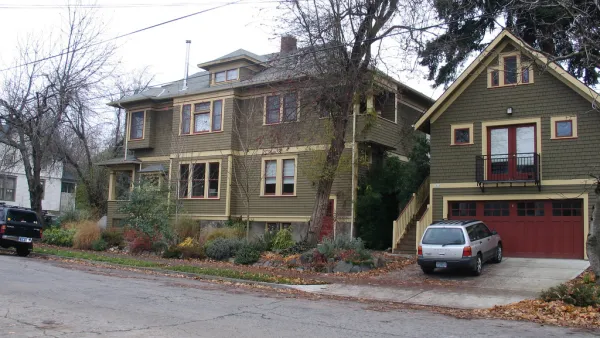
In an effort to densify and address affordable housing, cities make several key mistakes when it comes to "granny flats," according to CityLab. Vancouver-based writer and architect Bryn Davidson cites that city's accessory dwelling unit (ADU) policy as a successful model in a number of ways, including design, parking and approvals.
Five important recommendations include: implement ADU policy citywide rather than a neighborhood pilot project, don't burden the policy with caveats based on the existing unit on-site, don't solicit feedback from neighbors, don't let parking requirements overwhelm the policy, and don't force "style-matching."
Davidson concludes by writing:
"As for what’s next: we need to start talking about how our pleasant, tree-lined, single-family neighborhoods can evolve into pleasant, tree-lined multifamily neighborhoods."
Vancouver's ADU policy is arguably a big success, with more than 2,000 units built across the city since 2010.
Read the full story: How Cities Get 'Granny Flats' Wrong

Op-Ed: Seattle Merely 'Inching Forward' on ADUs
They're a good start. But compared to similar policies in cities like Portland and Vancouver, Seattle's new policies around accessory dwelling units may be lackluster.

'Making Room Housing Program' Would Allow New Density in Vancouver
Duplexes, rowhouses, and small apartment buildings will be on the zoning menu for "housing choice neighborhoods" around Vancouver, thanks to the city's new "Making Room Housing Program."

Vancouver's New 10-Year Housing Strategy Focuses on Rentals
Vancouver is famous for high-rises and a decidedly urban quality of life, but housing prices are still skyrocketing. A new ten-year housing strategy proposes a few drastic measures to rebalance the market's scales.

Planetizen Federal Action Tracker
A weekly monitor of how Trump’s orders and actions are impacting planners and planning in America.

Amtrak, CN end decades-long dispute with eight-year agreement
The new operating agreement establishes an updated framework for the companies to work together, including processes to resolve disputes.

Nation's most wind-powered state turns to coal as data centers increase energy demand
For the first time in decades, Iowa has increased its generation of coal power.

Alabama scores up to $2.5 billion federal loan for largest infrastructure project in state’s history
The Mobile River Bridge and Bayway Project aims to ease congestion at Alabama’s worst bottleneck.

Trump is considering data centers on 6 states' public land — some state officials say they had no idea
If the administration approves the proposed projects, data center and data center-related developments will cover 17,600 acres of public land.

Despite court ruling, Trump is keeping nearly all wind projects in the US on hold
At least 110 wind energy projects have not heard from the government since a federal judge ruled that the Trump administration's freeze on wind turbine clearances was likely illegal.

FREE Course: Walkable City 1: Why Walkability?
After describing his path towards focusing on walkability as the essence of good planning, Jeff Speck marches through his five principal reasons for making more walkable places.
Reinventing Malls: Planning Alchemy—Turning Gray Fields Into Gold
The course focuses on the opportunities and imperatives that shape reinvention of mall sites.

KFH Group Inc.
Greater Baltimore Committee
Eagle County Government
The Architects Foundation
University of Cincinnati Online
The Pocatello Development Authority
The Urban Renewal Agency of the City of Pocatello