A Tenth Circuit court ruled that private property owners can't prevent people from accessing 'corner-locked' public lands.


The U.S. Supreme Court declined to review a lower court decision about public lands, cementing public access to millions of acres of federal land in Wyoming, Utah, Colorado, New Mexico, Kansas and Oklahoma.
As Boris Botchev explains in The Regulatory Review, the Tenth Circuit appellate court decision in the case of Iron Bar Holdings v. Cape approves public access to 3.5 million acres of public lands that are "corner-locked" by private property, connecting only at corners where two lots meet. The practice is common across the West, where public, Native American and private lands are often distributed in a checkerboard pattern.
According to Botchev, "This checkerboard pattern of land ownership originated during the United States’ westward expansion, with Congress first dividing territory in the Land Ordinance of 1785 and later distributing it to settlers through the Preemption Act of 1841 and the Homestead Act. During this period, Congress also subsidized the development of railroads by granting them ownership of every other parcel in a 10-mile-wide strip as they laid tracks westward."
The case stemmed from several incidents in 2020 and 2021 when elk hunters in Wyoming crossed the corner of a private ranch to move across public lands. The ranch filed a lawsuit, but the court determined that the hunters were not in the wrong. "The appeals court held that, so long as members of the public do not 'physically touch' private property, they cannot be denied access to federal public lands."
While the appellate court decision only applies to the six states within its jurisdiction, the decision will likely impact millions of acres of other public lands. According to Botchev, "If these recent shared advocacy efforts by conservationists and environmentalists are viewed in combination with their joint efforts to open up corner-locked lands, they may signal a deeper alignment across a broader range of environmental issues in the years to come."
FULL STORY: Crossing Corners Across a Public Lands Checkerboard

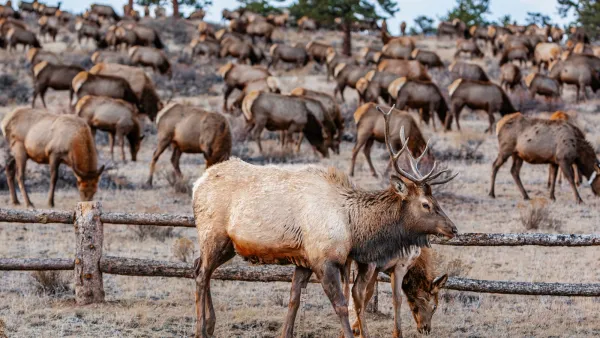
Colorado oil and gas land lease on public land could imperil nation's largest elk herd
The federal government approved the largest land lease to oil and gas interests in Colorado history.
September Must-Reads: Top 10 Articles From Last Month
EV drivers can no longer use carpool lanes alone, Bay Area transit is saved — for now — by a $750 million loan, and a Florida commuter rail line loses its state subsidy, jeopardizing its future.

Trump Administration Wants to Remove Conservation From Approved 'Uses' of Public Land
The Department of the Interior moved to officially rescind the Public Lands Rule passed in 2024, which elevates the conservation of public lands to the same level of protection as other uses.

Planetizen Federal Action Tracker
A weekly monitor of how Trump’s orders and actions are impacting planners and planning in America.

The state-sanctioned urbicide of Austin
People don’t kill cities. Freeways do.

US to reduce Colorado River water deliveries to Mexico
A new Colorado Treaty amendment reduces Mexico’s Colorado River water allocation by 250,000 acre feet.

Mamdani overhauls NYC's Vision Zero plan with 100 new policy goals
The overhaul aims to reduce traffic deaths and make streets safer for pedestrians, cyclists and drivers through lower speed limits, new safety infrastructure and more.

Amtrak not solely to blame for New Jersey commuter rail's unreliability, report finds
A new study from the Garden State Initiative found that NJ Transit’s budget grew 20% across a 4 year period, but reliability declined significantly over the same period.

EPA erases limits on planet-warming pollution from power plants
Under Monday’s plan, power plants would still have some limits on how much mercury, arsenic and other contaminants they can emit.

FREE Course: Walkable City 1: Why Walkability?
After describing his path towards focusing on walkability as the essence of good planning, Jeff Speck marches through his five principal reasons for making more walkable places.
Reinventing Malls: Planning Alchemy—Turning Gray Fields Into Gold
The course focuses on the opportunities and imperatives that shape reinvention of mall sites.

Eagle County Government
Harvard University Graduate School of Design
Nashville Planning Department
The Architects Foundation
University of Cincinnati Online
The Pocatello Development Authority
The Urban Renewal Agency of the City of Pocatello
Journal of the American Planning Association