Experts say the mayor’s focus on overnight-only shelters fails to get people into long-term housing with the supportive services they need.


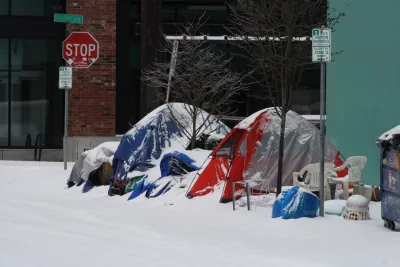
Homelessness is rising in Portland, Oregon despite campaign promises by Mayor Keith Wilson to end unsheltered homelessness, writes Wesley Vaughan in Shelterforce.
According to Vaughan, “[Wilson’s] plan centered on using existing infrastructure and partnering with current shelter providers to establish emergency low-barrier overnight and day shelters across the city, with a stated goal of creating 1,500 new shelter beds by Dec. 1, 2025.” The city has opened seven new overnight-only shelters and one day shelter.
“The execution of the mayor’s plan has drawn heavy criticism from across Portland’s political spectrum. Many experienced homeless services providers say the mayor’s version of shelter is the least effective at moving people out of survival mode and into stable housing. The plan has also been accused of a lack of transparency, especially considering the large expenditures involved.” Experts say the approach does not help people get into stable, long-term housing or provide supportive services and case management that people need to readjust and remain in housing.
Laura Golino de Lovato, head of Northwest Pilot Project (NWPP), suggests the funding should be used for rental assistance instead, and that the city could take other steps to reduce barriers to accessing housing.
FULL STORY: Portland’s Mayor Went All in on Overnight-Only Shelters. Homelessness Is Still Rising


Denver Cut Unsheltered Homelessness Almost in Half Even as Unhoused Population Grows
While the total number of Denver residents without permanent housing is growing, the city has leveraged its resources to quickly create over 1,000 new emergency shelter beds.

Investigation Reveals Just How Badly California’s Homeless Shelters are Failing
Fraud, violence, death, and chaos follow a billion dollar investment in a temporary solution that is proving ineffective.

Utah to Build New, 1,200-Bed Shelter Campus
The state’s attempt to decentralize emergency homeless shelters yielded poor results, leading to a decision to develop a “transformative” intake campus with wraparound services.

The state-sanctioned urbicide of Austin
People don’t kill cities. Freeways do.

US to reduce Colorado River water deliveries to Mexico
A new Colorado Treaty amendment reduces Mexico’s Colorado River water allocation by 250,000 acre feet.

New Jersey’s second-largest city bans standalone data centers
Jersey City will continue to allow co-location facilities, such as those meant for research institutions that store their own data.

Amtrak not solely to blame for New Jersey commuter rail's unreliability, report finds
A new study from the Garden State Initiative found that NJ Transit’s budget grew 20% across a 4 year period, but reliability declined significantly over the same period.

EPA erases limits on planet-warming pollution from power plants
Under Monday’s plan, power plants would still have some limits on how much mercury, arsenic and other contaminants they can emit.

Phoenix announces new on-demand transit service, more frequent RAPID buses
Both new services will launch in October, and are part of Phoenix's Project Effective Access Solutions for Easing Congestion.

FREE Course: Walkable City 1: Why Walkability?
After describing his path towards focusing on walkability as the essence of good planning, Jeff Speck marches through his five principal reasons for making more walkable places.
Reinventing Malls: Planning Alchemy—Turning Gray Fields Into Gold
The course focuses on the opportunities and imperatives that shape reinvention of mall sites.

Eagle County Government
Harvard University Graduate School of Design
Nashville Planning Department
The Architects Foundation
University of Cincinnati Online
The Pocatello Development Authority
The Urban Renewal Agency of the City of Pocatello
Journal of the American Planning Association