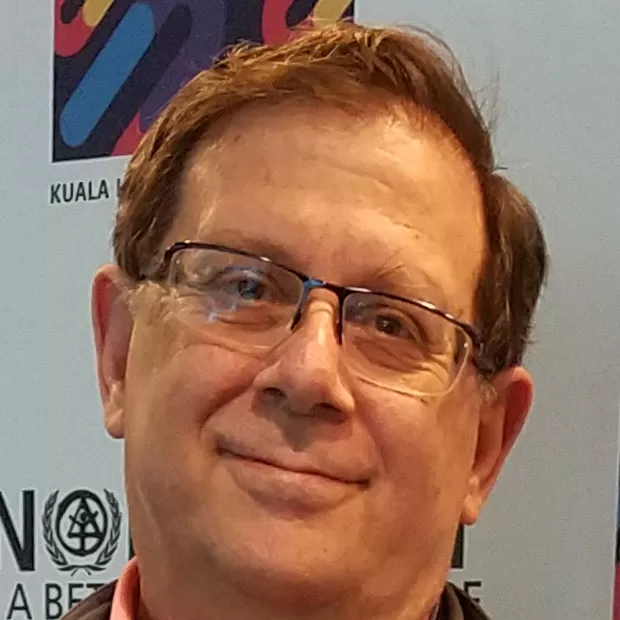
Bruce Stiftel, FAICP, is professor emeritus of city and regional planning at Georgia Tech. His research concerns planning theory, adaptive governance, and international development. He chairs the Planners for Climate Action knowledge/research group, co-chairs the Researcher and Academic Partner Constituency Group in the World Urban Campaign, co-chairs U.N. Habitat's University Network Initiative, and is a Director At-large of the American Planning Association.
A graduate of the State University of New York at Stony Brook, and of the University of North Carolina at Chapel Hill, Stiftel is former president of the Association of Collegiate Schools of Planning (ACSP), member of the Planning Accreditation Board, editor of the Journal of Planning Education and Research, founding chairperson of the Global Planning Education Association Network (GPEAN), and member of UN-Habitat's expert group on the International Guidelines on Urban and Territorial Planning.

UN-Habitat Adopts International Guidelines for Urban and Territorial Planning
UN-Habitat has adopted International Guidelines for Urban and Territorial Planning intended to inform the United Nation's New Urban Agenda and Sustainable Development Goals.
UN Sustainable Development Goals May Not Include Cities: Act Now!
UN-Habitat is about to decide on Sustainable Development Goals for the next 20 years. The "Urban Goal" is in danger. Please learn more and act.
Planning Accreditation Board seeks public comments on proposed new accreditation standards
<p class="MsoNormal"> The PAB is proposing a substantial revision of the standards and criteria for accreditation of university planning programs. A public comment period on the proposal has just opened and lasts through 15 December. Here's what PAB says about the changes: </p> <p> "PAB is pleased to introduce a comprehensive revision of its accreditation standards and criteria. <strong>The goals of the change process include:</strong> </p>
US Planning Isolationism
<p> Recently, the new <a href="http://www.planning.org/japa/" target="_blank" title="JAPA">Journal of the American Planning Association</a> editor Randall Crane circulated a message to US planning academics in which he asked for new submissions: </p> <p> <span style="font-size: 12pt; font-family: 'Times New Roman','serif'">"A reminder that JAPA is interested in your best work in any aspect of planning scholarship -- quantitative or qualitative, foreign or domestic -- that informs practice. We would particularly like to broaden subject content over the next few years." </span> </p> <p class="MsoNormal"> Temple Uni urban studies prof Ben Kohl replied: "For years I have wished that JAPA would show some interest in the lessons that ‘foreign’ planners and planning experience might have to offer.
The Studio: University-Community Partnerships in Microsize
<!-- /* Font Definitions */ @font-face {font-family:"Cambria Math"; panose-1:2 4 5 3 5 4 6 3 2 4; mso-font-charset:0; mso-generic-font-family:roman; mso-font-pitch:variable; mso-font-signature:-1610611985 1107304683 0 0 159 0;} @font-face {font-family:Calibri; panose-1:2 15 5 2 2 2 4 3 2 4; mso-font-charset:0; mso-generic-font-family:swiss; mso-font-pitch:variable; mso-font-signature:-1610611985 1073750139 0 0 159 0;} /* Style Definitions */ p.MsoNormal, li.MsoNormal, div.MsoNormal {mso-style-unhide:no; mso-style-qformat:yes; mso-style-parent:""; margin:0in; margin-bottom:.0001pt; mso-pagination:widow-orphan; font-size:11.0pt; font-family:"Calibri","sans-serif"; mso-fareast-font-family:Calibri; mso-fareast-theme-font:minor-latin; mso-bidi-font-family:"Times New Roman";} .MsoChpDefault {mso-style-type:export-only; mso-default-props:yes; font-size:10.0pt; mso-ansi-font-size:10.0pt; mso-bidi-font-size:10.0pt;} @page Section1 {size:8.5in 11.0in; margin:1.0in 1.0in 1.0in 1.0in; mso-header-margin:.5in; mso-footer-margin:.5in; mso-paper-source:0;} div.Section1 {page:Section1;} --> <p class="MsoNormal"> I had the pleasure of attending two studio final presentations at the Georgia Tech planning program this month: the Lindbergh/Lavista Community studio and the Friendship Village studio. I'm hardly a neutral observer: I chair the program; but I'm new here and really didn't know what to expect. I came away refreshed at the insights of the students and enthused at way the university partners with communities to advance good planning.