According to New York Yimby, Mayor de Blasio's proposed inclusionary zoning policy could do more to protect small market-rate developments, without affordable housing, than it will to create affordable units.


Rebecca Baird-Remba reports on a loophole in a mandatory inclusionary policy announced in July by New York Mayor Bill de Blasio. First, to summarize the policy, Baird-Remba writes that the city "will require market-rate developers to set aside at least 25% of their units in each new building as affordable housing."
The loophole, however: "New buildings with 10 units or less won’t have to abide by the new mandatory affordable rules." That creates a problem in East New York, where the policy will first be rolled out. That's because, according to Baird-Remba, in East New York "virtually all new market-rate construction is three or four-story masonry structures with fewer than 10 apartments."
The reality of the market that, according to Baird-Remba, render the inclusionary zoning policy ineffective on that side of town: "Taller steel-frame buildings cost more to build and are more to challenging to finance, particularly if they have subsidized units. Rents in the area simply aren’t high enough to justify the cost." According to New York YMIBY's archive, in fact, just one market-rate building above that threshold has filed permits in East New York all year long.
The article then explains how the East New York rezoning process will proceed, with a major release expected on September 21.
Sally Goldenberg reported on the critical component of this developing story, Mayor Bill de Blasio's proposal for mandatory inclusionary zoning, at the end of July.
Read the full story: The Loophole In De Blasio’s New Mandatory Inclusionary Zoning Policy

Mayor de Blasio Stresses Affordable Housing in State of the City Address
In his State of the City Address on Feb. 3, the New York City mayor made it clear that his overriding priority is affordable housing. He targeted six neighborhoods in all five boroughs where development will be required to include affordable housing.
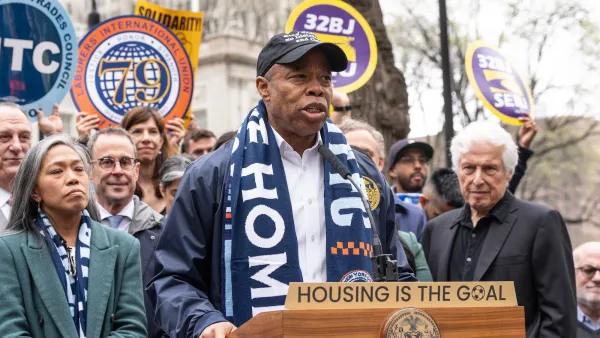
What Actually Got Built Under Eric Adams’ ‘Pro-Housing’ Administration
The outgoing mayor claims credit for hundreds of thousands of new homes. The truth is more complicated.
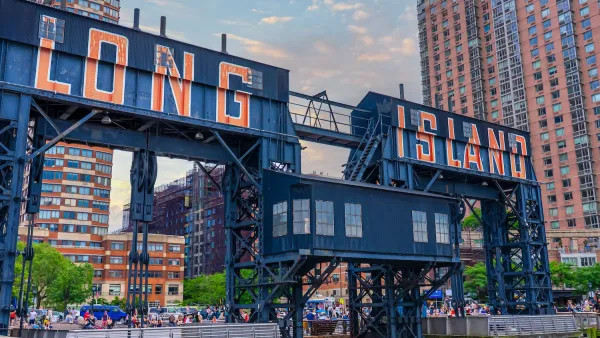
Upzoning Could Bring 15K New Homes to Queens
A rezoning plan for Long Island City opens up prime waterfront land for residential development, but some critics say new housing could be prone to flooding and should be built farther inland.

Planetizen Federal Action Tracker
A weekly monitor of how Trump’s orders and actions are impacting planners and planning in America.

Amtrak, CN end decades-long dispute with eight-year agreement
The new operating agreement establishes an updated framework for the companies to work together, including processes to resolve disputes.

Northwest rail fans eager for Sept. 30 debut of Amtrak’s Airo fleet
Get ready for that new train smell and more seats. But they won’t go faster or run more frequently on the Cascades route in Washington and Oregon.

LAX SkyLink opening delayed again, contractor won’t commit to new deadline
The project was supposed to open its doors to the public in 2023.

Caltrain may slash over one-third of its stations
If Bay Area voters reject two transit tax measures, Caltrain, BART and AC Transit will see steep service cuts.

A 'dangerous' precedent: North Carolina successfully pressures communities into voting for toll roads
Two mayors resigned from the Charlotte Regional Transportation Planning Organization after it voted in favor of the toll roads.

FREE Course: Walkable City 1: Why Walkability?
After describing his path towards focusing on walkability as the essence of good planning, Jeff Speck marches through his five principal reasons for making more walkable places.
Reinventing Malls: Planning Alchemy—Turning Gray Fields Into Gold
The course focuses on the opportunities and imperatives that shape reinvention of mall sites.

City of Thousand Oaks
City of Wisconsin Rapids
Harvard University Graduate School of Design
The Architects Foundation
University of Cincinnati Online
The Pocatello Development Authority
The Urban Renewal Agency of the City of Pocatello