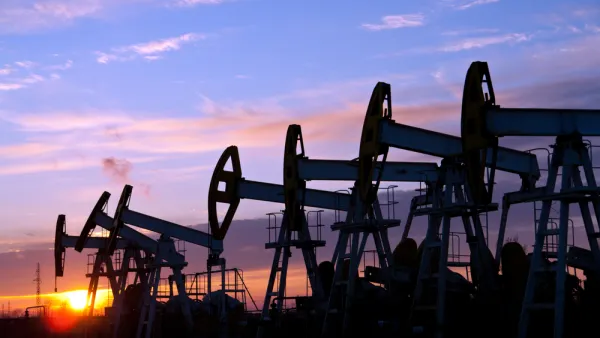
Oil prices plummeted 60 percent since last summer, yet American crude output will reach a record this year according to the Energy Information Administration's Fall Short-Term Energy Outlook. Gas prices will drop about 35 cents this year.


"Total U.S. crude oil production is expected to average 9.4 million barrels a day this year and 9.3 million barrels a day for 2016, the EIA report said," writes Rick Jervis of USA Today on the outlook. "Those are higher estimates than the EIA released last month."
What's remarkable about the record output—"highest for any month since 1972", is that it is occurring after a huge drop in oil prices.
The price for a barrel of West Texas Intermediate crude has ricocheted from more than $100 last summer to $40 in January to $60 this week [and forecasted] to average $55 a barrel this year and $62 a barrel in 2016, according to the report.
"The numbers run counter to conventional thinking that lower oil prices would severely drive down U.S. production," writes Jervis. In fact, energy companies are reducing drilling - fewer rigs are in service, but they've become more efficient and productive with the remaining ones.
One result of the record crude production is that gasoline prices will remain relatively low through 2016. "The EIA expects monthly average gasoline prices to decline the rest of the year, averaging $2.43 a gallon during the second half of 2015," writes Jervis. According to the AAA, gas prices average $2.78 on June 12.
Read the full story: Report: U.S. oil production to remain steady despite sagging prices
Plummeting Oil Prices Bring Economic Challenges to U.S. Petro-States
While U.S. motorists are enjoying the cheapest gas prices in five years, domestic oil producers are suffering, though not as badly as oil-exporting nations like Iran, Russia, and Venezuela. How are Texas, Louisiana, North Dakota, and Alaska faring?
Just What the Planet Needs: More Oil Production
A surge of oil from four countries—Norway, Guyana, Canada and Brazil—will more than compensate for slowing growth of U.S. oil production. The new sources might cause oil prices to dip to $50 a barrel and slow the transition to electric vehicles.
How Low Will Oil Prices Go?
Oil prices are now at a 12-year low. Prices have been very consistent this year: they have dropped every day. As they slide to going below $30 a barrel, service stations could be selling gasoline at $1 per gallon, a price not seen since 1999.

Planetizen Federal Action Tracker
A weekly monitor of how Trump’s orders and actions are impacting planners and planning in America.

California plans to bury El Niño’s downpour
If the state plays its cards right, it may be able to store a billion acre-feet of El Niño’s water in aquifers.

Desperate measures: Advocates weigh draining Lake Powell to fill Colorado River
Draining the reservoir could reduce evaporation losses by a couple hundred thousand acre-feet.

Mamdani’s pied-à-terre tax survives legal challenge
A panel of judges found that the plaintiffs failed to demonstrate injury as a result of New York City's implementation of the tax.

Eastern Nebraska is running out of electricity
Data centers and electrification are straining eastern Nebraska’s grid, throttling economic development.

Seattle passes record-breaking transit services expansion
Proposition 1 will double the city’s transit tax to add 95,000 more bus trips and preserve 180,000 bus trips annually.

FREE Course: Walkable City 1: Why Walkability?
After describing his path towards focusing on walkability as the essence of good planning, Jeff Speck marches through his five principal reasons for making more walkable places.
Reinventing Malls: Planning Alchemy—Turning Gray Fields Into Gold
The course focuses on the opportunities and imperatives that shape reinvention of mall sites.

City of Rosemead
Rutgers University, Edward J. Bloustein School of Planning and Public Policy
One Hundred Miles
University of Michigan School for Environment and Sustainability (SEAS)
Hunter College, City University of New York (CUNY)
The Architects Foundation
City of Cambridge
Montrose County
The Pocatello Development Authority