Most cities in the United States tax land according to what an owner builds on it. That's great if you're an owner, but lousy if you're a city that wants something cool built on it. The solution: tax it according to what an owner can build on it.


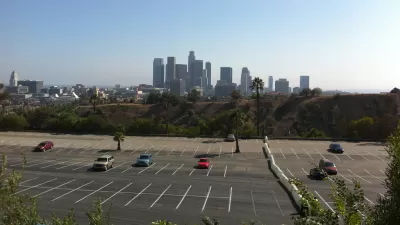
Cities across America are poxed by vacant lots. Dozens, or even hundreds, of perfectly good pieces of land lie fallow, perhaps as parking lots, thus breaking up the urban fabric in cities that are eager to develop and create great places. In some cases, landlords are just lazy. But in many cases, they are reaping a tax windfall.
Most cities tax land according to the price an owner paid and then according to the improvements—i.e., buildings—that the owner puts on the land. No improvements equal no increases in taxes. The relatively low taxes paid by owners of vacant lots enables them to bide their time, waiting for the distant moment when their parking lot is no longer profitable or when a developer comes willing to pay an extortionate sum.
Nearly a century-and-a-half ago, economist Henry George devised a "single tax" to solve this problem: tax all land at the same rate, regardless of improvements. If the owner of a parking lot is paying the same amount of taxes as the owner of a skyscraper, that parking lot will be dug up posthaste, or so George's logic goes. In Slate, Henry Grabar discusses a few communities, mostly small, none with great development pressures, that use version of the single tax. They include Allentown, Pa., Harrisburg, Pa., and Fairhope, Ala. They are not necessarily models for the country, but with backers like Peter Orszag endorsing the single tax, perhaps its time may be in the offing.
"Today the largest land taxes in the United States are in Allentown and Harrisburg, Pennsylvania, which employ, respectively, a fivefold and sixfold emphasis on taxing land vs. buildings. But they offer scant evidence for how such a policy might affect enormous, high-cost metropolises like Los Angeles or New York. The shift would cause huge changes in property values, and would have to be implemented over a period of years, if not decades, to be feasible."
Read the full story: The Land Taxers of Fairhope

Curbing House Flippers in Brooklyn
A new cease-and-desist zone, meant to control the activities of house flippers, is under consideration in the Brooklyn neighborhood of East New York, as well as state laws that would increase the real estate transfer tax.

Planned Transit Service Cuts Already Causing Problems for Businesses in Pennsylvania
With big cuts coming to Capital Area Transit bus service in Cumberland County, Pennsylvania, businesses are looking for new ways to get workers to their jobs.
Green Infrastructure Planning to Empower Communities
With the recently adopted Community Greening Plan, Capital Region Water has committed to the implementation of green stormwater infrastructure in Harrisburg. The plan is empowering residents to partner in stormwater management.

Planetizen Federal Action Tracker
A weekly monitor of how Trump’s orders and actions are impacting planners and planning in America.

Northwest rail fans eager for Sept. 30 debut of Amtrak’s Airo fleet
Get ready for that new train smell and more seats. But they won’t go faster or run more frequently on the Cascades route in Washington and Oregon.

Record-breaking wildlife overpass in Colorado brings 91% reduction in animal collisions
Prior to the overpass, vehicles were hitting one deer per day on Colorado’s Interstate 25.

Detroit to transform waterfront with $2.2 billion investment
Developers will convert about 18 acres of unused parking lot space into civic spaces.

‘Going backwards:’ Baltimore mayor, students rally against state's transit funding plan
Maryland's proposed six-year plan provides no funding for Baltimore’s BMORE bus program and reduces its road maintenance funding.

Trump wants to cancel nearly 98% of funding for HUD housing support program
Multiple housing groups are suing the administration in an effort to preserve the funding.

FREE Course: Walkable City 1: Why Walkability?
After describing his path towards focusing on walkability as the essence of good planning, Jeff Speck marches through his five principal reasons for making more walkable places.
Reinventing Malls: Planning Alchemy—Turning Gray Fields Into Gold
The course focuses on the opportunities and imperatives that shape reinvention of mall sites.

City of Thousand Oaks
City of Wisconsin Rapids
Harvard University Graduate School of Design
The Architects Foundation
University of Cincinnati Online
Northern Illinois Transit Authority (NITA)
The Pocatello Development Authority
The Urban Renewal Agency of the City of Pocatello