A recent post by Richard Florida, working in partnership with the Martin Prosperity Institute, examines where (and how much) income inequality grew in U.S. metros between 2006 and 2012.


To describe Florida's findings on inequality in broad strokes, the country's overall distribution in inequality is similar, but deepening. In fact, "income inequality has risen in roughly two thirds of all U.S. metros, both large and small."
For a more granular analysis, Florida provides the following among a number of maps and concepts used to describe the data presented in the article:
"New Orleans, Jacksonville, Salt Lake City, and Atlanta, among large metros, saw inequality rise the most. But the largest absolute increases in inequality occurred mainly in smaller metros in the South and throughout the middle of the country, including Columbia, Missouri; Wausau, Wisconsin; Ithaca, New York; Dalton, Georgia; St. George, Utah; Lewiston-Auburn, Maine; Corvallis, Oregon; Grand Forks, North Dakota; Hanford-Corcoran, California; and Anderson, South Carolina. In contrast, inequality only nudged up slightly in New York, D.C., L.A., San Jose, San Francisco and Boston."
Read the full story: Where the Great Recession Made Inequality Worse
Employment Growth in Large, Dense Cities Paces Recovery
A study from the Oregon Office of Economic Analysis finds evidence that large, dense metropolitan areas have experienced the most complete recovery following the Great Recession.
Despite Ailing Economy, Manufacturing Spurs Cities' Growth
Durham-Chapel Hill, North Carolina and Titusvilla, Florida are metropolitan areas that grew faster than the national average in 2010, reports Ben Casselman for The Wall Street Journal.
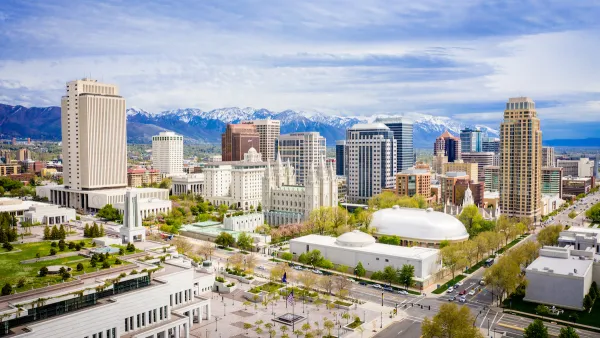
How Salt Lake City Maintained a Vibrant Downtown
Unlike other major cities, the Utah capital’s downtown has seen a steady stream of visitors even as demand for office space diminishes.

Planetizen Federal Action Tracker
A weekly monitor of how Trump’s orders and actions are impacting planners and planning in America.

California plans to bury El Niño’s downpour
If the state plays its cards right, it may be able to store a billion acre-feet of El Niño’s water in aquifers.

Desperate measures: Advocates weigh draining Lake Powell to fill Colorado River
Draining the reservoir could reduce evaporation losses by a couple hundred thousand acre-feet.

US buildings threatened, destroyed by fires set to triple by 2060
Researchers found a high fire risk for socioeconomically vulnerable neighborhoods in the American West.

LA residents may be allowed to paint their own crosswalks
Councilwoman Katy Yaroslavsky put out a motion instructing the Los Angeles Department of Public Transportation to study the feasibility of allowing volunteers to paint crosswalks.

Dallas moves to overhaul its zoning code
The city's zoning reform will allow more multi-family and mixed-use developments.

FREE Course: Walkable City 1: Why Walkability?
After describing his path towards focusing on walkability as the essence of good planning, Jeff Speck marches through his five principal reasons for making more walkable places.
Reinventing Malls: Planning Alchemy—Turning Gray Fields Into Gold
The course focuses on the opportunities and imperatives that shape reinvention of mall sites.

City of Rosemead
Rutgers University, Edward J. Bloustein School of Planning and Public Policy
One Hundred Miles
Hunter College, City University of New York (CUNY)
The Architects Foundation
University of Cincinnati Online
City of Cambridge
Montrose County
The Pocatello Development Authority