In a huge victory for fracking opponents and a major blow to the shale gas drilling industry, the New York Court of Appeals, the state's highest, ruled on June 30 that municipalities can use zoning laws to enact fracking bans or moratoria.


"In a precedent-setting ruling [PDF] that could have wide implications on the future of shale-gas drilling in New York and possibly elsewhere, the state Court of Appeals ruled 5-2 in favor of the towns of Dryden and Middlefield," writes Jon Campbell of USA TODAY on the ruling to allow New York State towns and cities to use their zoning codes to ban fracking.
"We conclude that they may because the supersession clause in the statewide Oil, Gas and Solution Mining Law does not pre-empt the home rule authority vested in municipalities to regulate land use," wrote Associate Judge Victoria Graffeo in the majority opinion.
As noted here in 2012, a state Supreme Court (in New York, the Court of Appeals is the highest, unlike the United States) ruled in favor of Dryden, a town near Cornell University, in allowing the use of its zoning code to ban fracking. We noted in May, 2013 that an Appellate Division court panel unanimously upheld that decision and also a 2011 fracking ban enacted by the Otsego County town of Middlefield.
More than 150 towns and cities in New York have passed a moratorium on fracking over the past six years, and drilling opponents are hopeful Monday's ruling will spur more to act.
High-volume hydrofracking has been on hold in New York since 2008, when then-Gov. David Paterson ordered the Department of Environmental Conservation to complete a lengthy environmental review. That review continues today under Gov. Andrew Cuomo, with no deadline for completion.
Joe Mahoney, staff writer for The (Oneonta) Daily Star in Otsego County captured this quote that referenced the small town charm prevalent throughout villages in upstate New York:
“The towns both studied the issue and acted within their home rule powers in determining that gas drilling would permanently alter and adversely affect the deliberately-cultivated, small-town character of their communities,” according to the majority ruling.
Challenging the local fracking bans were Anschutz Exploration Corp., a Colorado-based oil-and-gas company which was subsequently replaced by Norse Energy, and a Middlefield dairy farm, the Cooperstown Holstein Corp., which argued "that New York law gives full power to the state to regulate the industry," writes Campbell.
"New York is the second state in the Northeast, after Pennsylvania, to give municipalities the ability to trump state rules and curtail fracking. Courts in Colorado are examining the same issue," write Joseph De Avila, Mike Vilensky and Russell Gold in The Wall Street Journal.
"Despite the moratorium, New York has increased its use of natural gas. About 39% of the electricity it generates is from natural gas, up from 20% a decade ago, according to the federal government," notes the Journal, a paradox we noted last year in "New York Has it Both Ways on Natural Gas" which dealt with the conversion of burning dirty heating oil to cleaner natural gas in furnaces in order to reduce soot pollution from New York City's largest source.
Correspondent's note: Full access to Wall Street Journal article should be available for non-subscribers through July 9.
Read the full story: N.Y. towns can ban fracking, state court rules

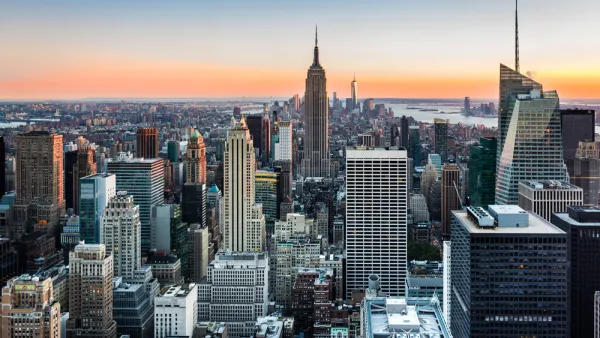
New York State, Not New York City, to Decide Whether to Toll Streets in Manhattan
While the city determines where to place parking meters and how much to charge, when it comes to charging tolls to drive in Manhattan, the city's elected leaders are excluded from the political process.
Polls: New York Fracking Ban Has Wide Support
According to a Quinnipiac University Poll, New Yorkers upstate, downstate, Democrat, and Republican, all supported Gov. Andrew Cuomo's decision to ban fracking—only energy companies and some businesses and property owners expressed dismay.
New York Bans Fracking for Good
Gov. Andrew Cuomo finally made a decision—make it permanent in 2015. Fracking foes won an important battle as the Empire State has massive natural gas reserves in the Marcellus shale play. In the end, health issues trumped economics.

Planetizen Federal Action Tracker
A weekly monitor of how Trump’s orders and actions are impacting planners and planning in America.

Amtrak, CN end decades-long dispute with eight-year agreement
The new operating agreement establishes an updated framework for the companies to work together, including processes to resolve disputes.

Judges permit Denver to divert 77,000 acre feet from the Colorado River for reservoir expansion
Overuse and climate change have caused the Colorado River’s water levels to plummet.

NYC DOT wants faster, more permanent street upgrades
The city is examining ways to build more concrete infrastructure without getting entangled in 'decades-long' projects.

'Something we’ve never seen before:' rising utility rates could strain city finances nationwide
Data centers, climate change and other factors have caused utility rates in the United States to increase by 38% since 2020.

Trump to overrule local leaders, lease millions of acres of America’s Pacific Island territories’ seafloors to mining companies
International law says that the Indigenous people of America’s territories have a right to prior and informed consent regarding projects that impact their countries.

FREE Course: Walkable City 1: Why Walkability?
After describing his path towards focusing on walkability as the essence of good planning, Jeff Speck marches through his five principal reasons for making more walkable places.
Reinventing Malls: Planning Alchemy—Turning Gray Fields Into Gold
The course focuses on the opportunities and imperatives that shape reinvention of mall sites.

KFH Group Inc.
Greater Baltimore Committee
Eagle County Government
The Architects Foundation
University of Cincinnati Online
The Pocatello Development Authority
The Urban Renewal Agency of the City of Pocatello