Loveland became the first city in Colorado to reject a voter-imposed moratorium on gas and oil hydraulic fracturing. Voters in five cities have approved moratoriums since 2012 though they are being contested by energy companies and the state.


Residents of Loveland, a city of 67,000 soundly defeated "Question 1, the only item on the city’s special election ballot which proposed a two-year moratorium on fracking and a study of the process’ potential health impacts," writes Ryan Maye Handy, Environment and Public Lands Reporter for The Fort Collins Coloradoan.
It lost by 900 votes, or 4.5% of the 20,000 ballots cast on June 24. Coincidentally, that's the same amount of total votes cast in Broomfield last year. That measure passed by a mere 20 votes, or .1%.
Colorado has a recent history of voter-approved opposition to fracking, beginning with Longmont in 2012; and in 2013 by Fort Collins, Lafayette, Boulder, and Broomfield, all Front Range cities.
One might ask why some of these ballot measures are held in the first place considering that "(i)t’s been years since any new wells were fracked in Loveland and there appear to be no new wells in the works," said Loveland Public Information Officer Tom Hacker.
Of interest to those who follow voter registration issues, one can register to vote the same day as the election in Colorado. Handy writes, "Loveland residents were casting votes and even registering until the eleventh hour on Tuesday. At one point would-be voters were sprawled on the office floor, registering to vote."
Abbreviated version of this article appears in Governing.
Read the full story: Loveland voters strike down fracking moratorium

Fracking Bans Fare Well in Colorado Elections
Fracking bans passed overwhelmingly in the Front Range cities of Boulder, Fort Collins and Lafayette but appeared to be losing by a mere 248 votes in Broomfield as of 11 p.m. on election night.
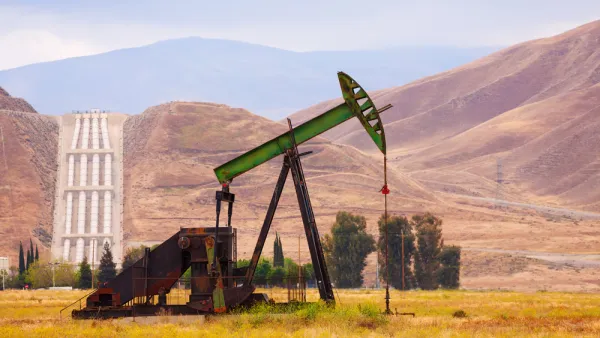
New Oil and Gas Drilling in California May Be Subject to Moratorium
Gov. Gavin Newsom pleased environmentalists by doing what his predecessor, Gov. Jerry Brown, refused – halting all new oil and gas fracking and placing a moratorium on another extraction method linked to a massive oil spill in Kern County.

How Environment and Energy Ballot Measures Fared in Tuesday's Election
More than the president was decided. Results are in on a Washington carbon tax, a California plastic bag ban, a Sunshine State restriction on solar panels, and on a ban on oil drilling in a California county that actually has oil drilling.

Planetizen Federal Action Tracker
A weekly monitor of how Trump’s orders and actions are impacting planners and planning in America.

Amtrak, CN end decades-long dispute with eight-year agreement
The new operating agreement establishes an updated framework for the companies to work together, including processes to resolve disputes.

Judges permit Denver to divert 77,000 acre feet from the Colorado River for reservoir expansion
Overuse and climate change have caused the Colorado River’s water levels to plummet.

NYC DOT wants faster, more permanent street upgrades
The city is examining ways to build more concrete infrastructure without getting entangled in 'decades-long' projects.

'Something we’ve never seen before:' rising utility rates could strain city finances nationwide
Data centers, climate change and other factors have caused utility rates in the United States to increase by 38% since 2020.

Trump to overrule local leaders, lease millions of acres of America’s Pacific Island territories’ seafloors to mining companies
International law says that the Indigenous people of America’s territories have a right to prior and informed consent regarding projects that impact their countries.

FREE Course: Walkable City 1: Why Walkability?
After describing his path towards focusing on walkability as the essence of good planning, Jeff Speck marches through his five principal reasons for making more walkable places.
Reinventing Malls: Planning Alchemy—Turning Gray Fields Into Gold
The course focuses on the opportunities and imperatives that shape reinvention of mall sites.

KFH Group Inc.
Greater Baltimore Committee
Eagle County Government
The Architects Foundation
University of Cincinnati Online
The Pocatello Development Authority
The Urban Renewal Agency of the City of Pocatello