A recent Wall Street Journal editorial calls for "Topic-specific, industry-led, and place-based…public-private hubs" as the key to a manufacturing renaissance. The idea is already being tested in four cities.


"Congress and the White House should go large and create the full proposed network of 45 manufacturing innovation institutes,"
Mark Muro opines on the possibility of innovation institutes: "First proposed in March 2012 and formally requested in President Obama’s 2013 State of the Union address, the National Network of Manufacturing Institutes (NNMI) vision calls for the investment of $1 billion in a set of 15 manufacturing innovation hubs (en route to a projected 45). So far, the government has created four of the hubs using existing money (in Youngstown, Chicago, Detroit, and Raleigh), and initiated the creation of four more, without congressional support. But this is where I want to just say: Go for it! Fund all 45 of the envisioned centers and let’s kick the manufacturing renaissance into high gear!"
As for why, according to Muro, "the manufacturing hubs idea reflects a growing consensus that the nation needs to forge a series of more urgent, technology-specific partnerships between business and academia to solve critical manufacturing problems and develop the next generation of cutting-edge technologies for making new, globally competitive products."
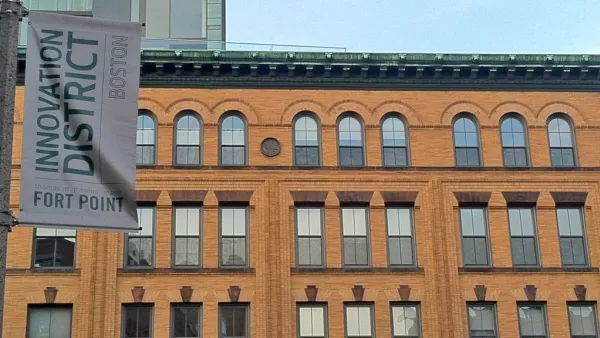
The Brookings Institution, for which Muro works, will release a new report today, June 9, called "The Rise of Innovation Districts." From the Bookings site announcing the report: "In contrast to suburban corridors of isolated corporate campuses, innovation districts combine research institutions, innovative firms and business incubators with the benefits of urban living. These districts have the unique potential to spur productive, sustainable, and inclusive economic development."
Read the full story: The Silver Bullet to a U.S. Manufacturing Revival

Checking-in with the Proliferation of Innovation Districts
A look at where innovation districts have caught on, and where to expect more of this type of concerted cooperation between public and private entities and commercial and residential land uses.

$1.9 Billion in Development Investment Planned for Pittsburgh's Innovation District
Pittsburgh has one of the most lucrative innovation districts in the country, and even more development investment is on the way.
Status Report: the Rise of Innovation Districts
Last year, the "innovation district" rose to prominence as a way to describe urban knowledge economy epicenters. This report from Bruce Katz and Brookings describes how the phenomenon continues to evolve.

Planetizen Federal Action Tracker
A weekly monitor of how Trump’s orders and actions are impacting planners and planning in America.

Amtrak, CN end decades-long dispute with eight-year agreement
The new operating agreement establishes an updated framework for the companies to work together, including processes to resolve disputes.

Judges permit Denver to divert 77,000 acre feet from the Colorado River for reservoir expansion
Overuse and climate change have caused the Colorado River’s water levels to plummet.

SEPTA to bring nearby frequent transit to over 1 million new riders as part of decade-long plan
The agency's Accelerate plan will also bring frequent transit to twice the amount of jobs that are currently located near it.

NYC plants over 18,000 trees, the most new foliage in a decade
Many of the trees were planted in communities vulnerable to extreme heat.

New bill requires California data center developers to create water scarcity plans
Gov. Gavin Newsom recently signed 7 bills intended to give California communities more information about the impact of proposed data centers.

FREE Course: Walkable City 1: Why Walkability?
After describing his path towards focusing on walkability as the essence of good planning, Jeff Speck marches through his five principal reasons for making more walkable places.
Reinventing Malls: Planning Alchemy—Turning Gray Fields Into Gold
The course focuses on the opportunities and imperatives that shape reinvention of mall sites.

City of Wisconsin Rapids
Harvard University Graduate School of Design
KFH Group Inc.
The Architects Foundation
University of Cincinnati Online
The Pocatello Development Authority
The Urban Renewal Agency of the City of Pocatello