Like many cities amidst an influx of Millennials, Philadelphia must solve problems with crime and eduction for the young generation to stay. A new report from Pew Charitable Trusts indicates many Millennials have no intentions of sticking around.


Just because Millennials have been moving back to cities in droves, doesn’t mean that they’ll stick around long enough to raise children or grow old with their newly adopted cities.
Julie Shaw reports that a new poll from Pew Charitable Trusts about the opinions of Millennials in Philadelphia shows just how difficult a task it might be to get the younger set to stick around as they grow older. “Half of the 20- to 34-year-olds questioned said they definitely or probably would not be living in Philadelphia five to 10 years from now, compared with about 3 in 10 for the rest of the city's adult population.”
Shaw also provides some insight on why the Millennials might eventually leave: “Of the young adults polled, 56 percent said they would not recommend the city as a place to raise kids, while only 36 percent said they would.”
Read the full story: Pew: Despite recent "boom," millennials likely to leave Philly

Philadelphia Sees Record Housing Production
An influx of millennials is driving population and housing growth in the Center City neighborhood.
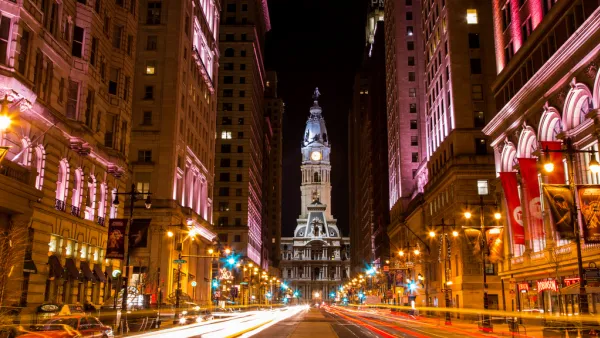
Is the Millennial Political Revolution Beginning in Philadelphia?
Philadelphia Inquirer Architecture Critic Inga Saffron writes of a possible political awakening among Millennials in Philadelphia in response to the old guard's efforts to stifle progressive parking and zoning decisions.
Learning loss and urban schools, part 2
Did test scores in progressive cities drop more post-COVID than test scores in moderate ones?

Planetizen Federal Action Tracker
A weekly monitor of how Trump’s orders and actions are impacting planners and planning in America.

California plans to bury El Niño’s downpour
If the state plays its cards right, it may be able to store a billion acre-feet of El Niño’s water in aquifers.

Desperate measures: Advocates weigh draining Lake Powell to fill Colorado River
Draining the reservoir could reduce evaporation losses by a couple hundred thousand acre-feet.

Mamdani’s pied-à-terre tax survives legal challenge
A panel of judges found that the plaintiffs failed to demonstrate injury as a result of New York City's implementation of the tax.

Eastern Nebraska is running out of electricity
Data centers and electrification are straining eastern Nebraska’s grid, throttling economic development.

Seattle passes record-breaking transit services expansion
Proposition 1 will double the city’s transit tax to add 95,000 more bus trips and preserve 180,000 bus trips annually.

FREE Course: Walkable City 1: Why Walkability?
After describing his path towards focusing on walkability as the essence of good planning, Jeff Speck marches through his five principal reasons for making more walkable places.
Reinventing Malls: Planning Alchemy—Turning Gray Fields Into Gold
The course focuses on the opportunities and imperatives that shape reinvention of mall sites.

City of Rosemead
Rutgers University, Edward J. Bloustein School of Planning and Public Policy
One Hundred Miles
University of Michigan School for Environment and Sustainability (SEAS)
Hunter College, City University of New York (CUNY)
The Architects Foundation
City of Cambridge
Montrose County
The Pocatello Development Authority