By analyzing the areas of expertise and interests of 851 undergraduate and graduate planning faculty members, Tom Sanchez investigates what planning is, what it is not, and what it could be.


As we know, the field of urban planning is far reaching in breadth and depth. This is due to the complex nature of cities, regions, and associated development patterns. Referring to the ambitious field of urban planning, Aaron Wildavsky famously remarked, “If planning is everything, maybe it’s nothing” (Wildavsky, 1973). Is planning everything? And what does that mean for someone trying to understand planning?
Using a recent Guide to Undergraduate and Graduate Education in Urban and Regional Planning (17th Edition, dated 2011) published by the Association of Collegiate Schools of Planning [PDF], I examined the question of “what is planning?” by analyzing the areas of expertise and interests for the 851 regular faculty listed in the Guide. These are self-reported areas of teaching and research interests that can be used to characterize contemporary aspects of planning. Rather than just reporting the frequency of topics mentioned across planning faculty, network analysis was used to illustrate the range and interconnections between topics.
The analysis was performed by using the “raw” areas of interest reported by planning faculty. For 851 faculty this resulted in 3,086 total topics, of which 1,511 were unique. The challenge here is that many topics can be referred to in a variety of ways, some having similar meanings, while others represent nuances and variations. For instance, “Water Resource Management and Policy” likely has a relatively common meaning shared by the faculty that listed “Water Resources”, “Water Resource Management”, “Water Resource Planning”, and “Water Resource Policy”. On the other hand, “Planning”, “Planning and Policy”, and “Planning and Politics” may have very different coverage in terms of teaching and scholarship. To reduce these all to “Planning” would ignore notable subareas of teaching and research.
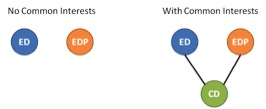
From a network perspective, however, the relatedness of topics can be better characterized because while particular topics may be referred to differently, the other topics listed by faculty with common interests can “relate” them in the network and therefore, decrease the “distance” or separateness. For instance, one faculty member listed “Economic Development” and another faculty member listed “Economic Development Planning”. Based on these seemingly similar topics (although referred to differently), these two topics (and faculty) would not necessarily be near each other in the network. However, if both also mention “Community Development” as an area of interest, then they would be more closely situated in the network. Indirectly, Economic Development and Economic Development Planning become associated (See Figure 1). The association is strong or weak depending on the frequency of overlapping faculty interests.
Results
Because of the large number of topics (nodes) and ties in the network, it is difficult to identify distinct clusters. This is not only a function of the number of nodes, but also the density resulting from strong connections among the core topics identified. The top 20 topics by degree centrality (number of faculty mentioning the topic) are shown below:


Figure 2. Full planning topics network
And the top 20 topics by betweenness centrality (centrality based on number of times the node is within a shortest path among all nodes) are shown below:

One notable characteristic of the planning topic network is the overall density and relative compactness. Evidence of this can also be seen in the fact that the top 20 topics by degree centrality are nearly the same as the top 20 topics by betweenness centrality. Nodes high in betweenness centrality commonly serve as “bridges” between clusters of nodes that are separated in the network. Three topics are in the list of the top 20 topics by betweenness centrality that were not included in the top 20 for degree centrality. These are “Planning Methods”, “Housing and Community Development”, and “Transportation Planning”. Each of these are fairly broad areas that serve to connect a wide range of topics within the network.
Community Development (CD) was the most central topic mentioned by planning faculty. CD had 152 first degree connections (i.e., faculty mentions) which represents 10.1% of the network. Second degree connections (i.e., includes connections to the 152 first degree connections) reach 843 nodes or 55.8% of the network. And third degree connections (includes connections to the second degree connections) reach 1,169 nodes or 77.3% of the network. This gives an indication of the prominence of CD among urban planning faculty.

Figure 3. Community Development Subnetwork
So, is planning everything? No, but close. The results of this analysis show that there is a core of faculty interests that are highly connected and central. In particular, the top 20 topics mentioned also correspond with many of the specializations listed by the American Planning Association (see “What Specializations Are Common in the Planning Profession?”). This seems to support the notion that planning academics are teaching and researching topics relevant to practitioners while at the same time pursuing a wide variety of other scholarly topics.
Planning is also dynamic. It is interesting to note the prominence of GIS and Sustainable Development among the list of more traditional planning topics and it is likely that new topics will emerge (or re-emerge under new terminology). But what topics are missing? For instance, social issues are not explicitly represented on the top ranked list although many are associated with topics like community development, housing, and planning theory. While there are 35 topics listed that include the word “social” they only have an average degree centrality of 6.7 compared to the overall average of 6.8 for all 1,511 topics mentioned. In addition, these 35 topics have an average betweenness centrality of 687 compared to 1,260 for the total list. What this means is that topics about social issues are not only infrequent, but also not well connected throughout the network.
These data can be used to answer many other questions that can help better explain what planning is, what it is not, and what it could be.
Tom Sanchez earned his PhD in City Planning from Georgia Tech and has since taught at Iowa State University, Portland State University, the University of Utah, and is currently professor of Urban Affairs and Planning at Virginia Tech. In 2012 he co-authored, Planning as if People Matter: Governing for Social Equity (Island Press) with Marc Brenman. He is on Twitter at @tomwsanchez.


How Local Planners Can Lead a Proactive, Aggressive Response to the Pandemic
The novel coronavirus has so far preyed on the most vulnerable in cities, as a result of the planning failures of the previous century. Planners today can take steps to reverse that reality, if they reclaim their historic role.

Which Urban Planning Academics Use Twitter and How
About 1/3 of planning faculty members use Twitter in a professional capacity. Semantic and network analysis of their Twitter use is helpful for reading the pulse of the field.

Planetizen Federal Action Tracker
A weekly monitor of how Trump’s orders and actions are impacting planners and planning in America.

‘Going backwards:’ Baltimore mayor, students rally against state's transit funding plan
Maryland's proposed six-year plan provides no funding for Baltimore’s BMORE bus program and reduces its road maintenance funding.

Detroit to transform waterfront with $2.2 billion investment
Developers will convert about 18 acres of unused parking lot space into civic spaces.

U.S.-Iran war may have ‘devastating’ impact on cost to warm homes
Vermont and Maine residents may see a 76% increase in the cost of warming their homes this winter.

Senate bill would ‘overhaul’ environmental permitting laws
Under the proposed act, government agencies would also not be able to suspend or rescind permits after granting them.

Exemption applications for NYC’s pied-à-terre tax see 55% success rate
The city sent nearly 40% of its initial pied-à-terre tax warnings erroneously.

FREE Course: Walkable City 1: Why Walkability?
After describing his path towards focusing on walkability as the essence of good planning, Jeff Speck marches through his five principal reasons for making more walkable places.
Reinventing Malls: Planning Alchemy—Turning Gray Fields Into Gold
The course focuses on the opportunities and imperatives that shape reinvention of mall sites.

One Hundred Miles
County of Mendocino
planning NEXT
The Architects Foundation
University of Cincinnati Online
Montrose County
Northern Illinois Transit Authority (NITA)
The Pocatello Development Authority

