North Carolina’s Research Triangle Park has a problem: the massive business park is woefully outdated, in both economic and architectural terms. Can it regain its status as a cutting-edge center of innovation by taking a page from the New Urbanism?


Built in the 1950s, the 7,000-acre campus—once a shining example of the suburbanization of American industry—is today home to more than 170 companies, including IBM, Cisco, and GlaxoSmithKline. But retaining existing residents, and attracting new ones, is increasingly difficult in today’s economy, where research and development occupy less physical space, and where many start-ups gravitate toward urban centers.
Bob Geolas, the chief executive officer of the campus’s foundation, wants to make Research Triangle Park relevant again, James Oliphant writes. Geolas envisions a new “global convergence center” housing laboratory space, plus a demonstration space akin to Disney’s EPCOT. The guiding architectural principle of the renovated park, which is in its earliest planning stages, would be New Urbanism’s emphasis on contact and sustainability.
FULL STORY: Can North Carolina Reinvent the Office Park?

North Carolina Planners: Where to Build Light Rail (and Should it Be Built)?
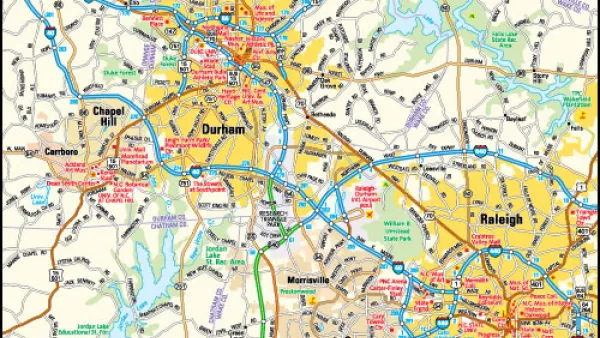
This week residents in the North Carolina Triangle (Raleigh-Durham-Chapel Hill) will provide input on key segments of a future regional light rail system. The project has been analyzed for 15 years, yet the question of whether to build it remains.

North Carolina Triangle transit ridership jumped 32% in April
Rising gas prices are prompting more Americans to consider public transit, where it's available.

Northwest Arkansas grapples with growth as it prepares to host New Urbanism gathering
A compelling story of a fast-growing, polycentric region grappling with identity and affordability, Susan Henderson reframes CNU 34 as a hands-on workshop, inviting planners to explore Northwest Arkansas as it decides what it will become.

The state-sanctioned urbicide of Austin
People don’t kill cities. Freeways do.

US to reduce Colorado River water deliveries to Mexico
A new Colorado Treaty amendment reduces Mexico’s Colorado River water allocation by 250,000 acre feet.

New Jersey’s second-largest city bans standalone data centers
Jersey City will continue to allow co-location facilities, such as those meant for research institutions that store their own data.

Amtrak not solely to blame for New Jersey commuter rail's unreliability, report finds
A new study from the Garden State Initiative found that NJ Transit’s budget grew 20% across a 4 year period, but reliability declined significantly over the same period.

EPA erases limits on planet-warming pollution from power plants
Under Monday’s plan, power plants would still have some limits on how much mercury, arsenic and other contaminants they can emit.

Phoenix announces new on-demand transit service, more frequent RAPID buses
Both new services will launch in October, and are part of Phoenix's Project Effective Access Solutions for Easing Congestion.

FREE Course: Walkable City 1: Why Walkability?
After describing his path towards focusing on walkability as the essence of good planning, Jeff Speck marches through his five principal reasons for making more walkable places.
Reinventing Malls: Planning Alchemy—Turning Gray Fields Into Gold
The course focuses on the opportunities and imperatives that shape reinvention of mall sites.

Eagle County Government
Harvard University Graduate School of Design
Nashville Planning Department
The Architects Foundation
University of Cincinnati Online
The Pocatello Development Authority
The Urban Renewal Agency of the City of Pocatello
Journal of the American Planning Association