The Economist's Intelligence Unit has once again ranked Melbourne as the top city in its annual Global Liveability Ranking. Damascus has dropped to the bottom of the list due to Syria's ongoing civil war.


For the third year in a row, Melbourne has topped the Economist Intelligence Unit's annual Liveability report, narrowly edging out Vienna, Vancouver, and Toronto. "The ranking scores 140 cities on a scale of zero to 100 for each of 30 factors such as the quality of public healthcare or the threat of military conflict."
"A glance at the top ten shows that the cities that do best are mid-sized conurbations in countries with low population densities, because such conditions will often result in low crime, working infrastructure and lots of recreational activities," notes The Economist's Graphic Detail blog. "The comparatively poor performances of London and New York can be mainly attributed to their stability scores, which are low because of a perceived terrorism risk."
Read the full story: Movers and shakers on the EIU’s city liveability ranking

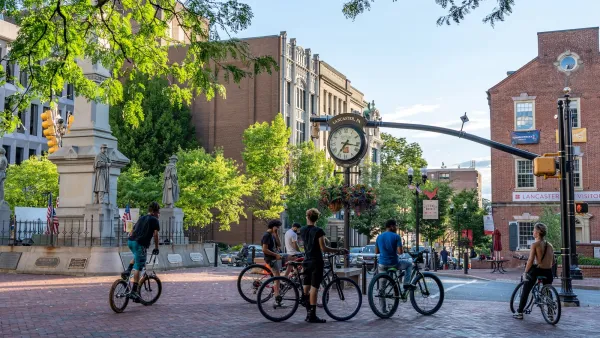
The Nation’s Best Small Cities Ranked by Livability, Affordability
A new list looks at a range of factors from housing costs to entertainment to commute times to rank the most attractive small cities in the U.S.

Singapore: A Model for Longevity and Quality of Life
Singapore's remarkable rise in life expectancy, driven by government policies on health, green spaces, and social cohesion, has earned it the distinction of being named the world's sixth “Blue Zone.”

Insights From the Latest Livability Index
The latest edition of the AARP Livability Index reveals the U.S. regions with more of the kinds of neighborhoods that offer quality of life benefits for residents of all ages.

Planetizen Federal Action Tracker
A weekly monitor of how Trump’s orders and actions are impacting planners and planning in America.

‘Going backwards:’ Baltimore mayor, students rally against state's transit funding plan
Maryland's proposed six-year plan provides no funding for Baltimore’s BMORE bus program and reduces its road maintenance funding.

Detroit to transform waterfront with $2.2 billion investment
Developers will convert about 18 acres of unused parking lot space into civic spaces.

HUD modernizes 50-year-old manufactured housing framework
The Next Generation Manufactured Housing Action Plan establishes new energy-efficiency standards for manufactured homes, and new guidelines for anchoring them.

New CA housing laws tear down development red tape
Recently-signed legislation makes building starter homes and ADUs cheaper and faster in California.

Metrolink finishes first expansion in 20 years
The transit agency is now one of very few in the United States to connect two major airports.

FREE Course: Walkable City 1: Why Walkability?
After describing his path towards focusing on walkability as the essence of good planning, Jeff Speck marches through his five principal reasons for making more walkable places.
Reinventing Malls: Planning Alchemy—Turning Gray Fields Into Gold
The course focuses on the opportunities and imperatives that shape reinvention of mall sites.

County of Mendocino
planning NEXT
City of Thousand Oaks
The Architects Foundation
University of Cincinnati Online
Montrose County
Northern Illinois Transit Authority (NITA)
The Pocatello Development Authority