Planners are futurists, but with less pretension and jargon. Our work requires predicting how current trends are likely to affect future conditions and activities, and how communities should prepare. For example, let's predict self-driving cars.



It’s premature to fire the chauffeur: the Jetson’s future has not yet arrived.
That is the conclusion of my current research. I recently completed a new report, Autonomous Vehicle Implementation Predictions: Implications for Transport Planning, which explores the implications of autonomous (self-driving) vehicles for transportation planning. It identifies their potential benefits and costs, predicts their likely development and deployment patterns, and how they will affect transport planning decisions such as road and parking supply and public transit demand.
The analysis indicates that some benefits, such as independent mobility for affluent non-drivers, may begin in the 2020s or 2030s, but most impacts, including independent mobility for low-income people (and therefore reduced need to subsidize public transport), reduced traffic congestion and parking demand (and therefore facility cost savings), increased traffic safety, energy conservation and pollution reductions, will only be significant when autonomous vehicles become affordable and represent a major portion of total vehicle travel, in the 2040s through 2060s, and some benefits may require prohibiting human-driven vehicles, which will take even longer.
While working on this study I received feedback from followers of various futurists who believe that autonomous vehicles will be deployed more quickly and provide greater benefits than my analysis indicates.
Well, I’ve got news. Planners are futurists. Our job entails predicting how current trends are likely to affect future conditions and activities, and what communities should do to prepare. We are futurists with less pretension and jargon.
Futurists are the alchemists of the planning world; they delight in the magic of technology, and use vague terms such as “convergences” and “synergies,” the sort of twaddle intended to convince people that they know more than they actually do. They generally lack critical and quantitative analysis.
For example, futurists claim that, self-driving cars will virtually eliminate accidents, traffic congestion and parking problems, and provide unlimited mobility for people with disabilities. The only downside they mention is the loss of taxi, bus and truck driving jobs. As a planner, I want comprehensive analysis that considers all impacts (benefits and costs). Below I’ve copied the more detailed analysis of impacts from my report.
Autonomous Vehicle Expected Benefits and Costs
Expected Benefits |
Expected Costs/Problems |
|
Reduced driver stress. Reduce the stress of driving and allow motorists to rest and work while traveling.
Reduced hired driver costs. Reduce costs of paid drivers for taxis and commercial transport.
Independent mobility for non-drivers. Provide independent mobility for non-drivers, and therefore reduce the need for motorists to chauffeur non-driving family members and friends, and the need to provide conventional public transit services.
Increased safety. Avoid many common accident risks and therefore reduce crash costs and insurance premiums. It allows motorists to avoid high-risk driving, such as when impaired by alcohol or drugs, and may allow courts to restrict or revoke frequent offenders’ driving privileges.
Increased road capacity, reduced roadway costs.May allow vehicles to operate closer together, reduce lane widths, and possibly allow vehicles to maneuver through intersections without stopping, reducing traffic congestion and roadway costs.
More convenient parking, reduced parking costs. Can drop off passengers and find a parking space, increasing motorist convenience and reducing total parking costs.
Increase fuel efficiency and reduce pollution. May increase fuel efficiency and reduce pollution emissions.
Supports shared vehicles. Could facilitate carsharing (vehicle rental services that substitute for personal vehicle ownership), which may reduce vehicle ownership, providing additional savings.
|
Increase production costs. Require additional sensors, computation and control systems, and possibly additional roadway infrastructure.
Additional risks. May provide less safety than predicted and introduce new risks. They may increase pedestrian and cycling risks; be unsafe under special conditions such as ice and snow; encourage transport system users to take additional risks (called “offsetting behavior”); or be vulnerable to malicious abuse.
Security and Privacy concerns. May be vulnerable to information abuse (hacking), and features such as GPS tracking and data sharing may raise privacy concerns.
Induced vehicle travel and increased external costs. By increasing automobile travel convenience and affordability, autonomous vehicles may induce additional vehicle travel, increasing external costs such as parking subsidies, accidents and pollution emissions.
Social equity concerns. May have unfair impacts, for example, if their implementation reduces the convenience and safety of other modes.
Misplaced planning emphasis. Focusing on technological solutions may discourage communities from implementing conventional but cost-effective transport system improvements such as better pedestrian, cycling and public transit conditions, pricing reforms and other demand management strategies.
|
Similarly, recent announcements that major manufactures plan to sell autonomous vehicles in a few years have led futurists to claim that such vehicles will be common in the next decade. However, more critical analysis suggests that autonomous vehicles will not be affordable and common for at least four decades: two to fully develop the technology and reduce price premium, and two more to become a significant portion of the vehicle fleet. Vehicle innovations tend to be implemented more slowly than other technological change due to their high costs, strict safety requirements, and slow fleet turnover. Automobiles typically last ten times as long and cost fifty times as much as personal computers and mobile phones, so consumers seldom purchase new vehicles and scrap their old ones simply to obtain a new technology. Large increases in new vehicle purchase, expenditure and scrappage rates would be required for most vehicles to be autonomous before 2050.
Futurists tend to focus on technology; their main question is "what is possible?" Planners, in contrast, generally begin by thinking about people and economics; we ask, "What is best overall, considering all impacts and perspectives?" For example, self-driving vehicles will not be affordable to lower-income households until they dominate the used vehicle market, which takes several decades after they are first introduced, and it is possible that many people will prefer driving, just as many motorists prefer manual transmissions. It is therefore likely that we must plan for mixed traffic with both human and self-driving vehicles. Managing this will probably raise fairness issues concerning who should get priority, and who should bear various costs. These are interesting and important issues; that is our realm.
The world needs practical futurists: planners!
References
Allison Arieff (2013), “Driving Sideways”, New York Times, 23 July 2013.
Tom Bamonte (2013), “Autonomous Vehicles: Drivers for Change,” Roads and Bridges, Summer, pp. 5-10.
Thomas Fray (2013), Driverless Cars: A Driving Force Coming to a Future Near You, Futurist Speak.
Ryan Holeywell (2013), “6 Questions States Need to Ask About Self-Driving Cars,”Governing Magazine, 14 August 2013.
Eric Jaffe (2013), Let's All Stop Obsessing About the 'Next Great Thing' in Urban Transportation, Atlantic Cities.
Todd Litman (2013), Autonomous Vehicle Implementation Predictions: Implications for Transport Planning, Victoria Transport Policy Institute.
Jerome M. Lutin, Alain L. Kornhauser and Eva Lerner-Lam (2013), “The Revolutionary Development of Self-Driving Vehicles and Implications for the Transportation Engineering Profession,”ITE Journal, July, pp. 21-26.
Paul Saffo and Andrew Bergbaum (2013), “Are Completely Self-Driving Cars Feasible In The Foreseeable Future?,”The Economist, 3 May 2013.
TRB (2011), Workshop on Road Vehicle Automation.

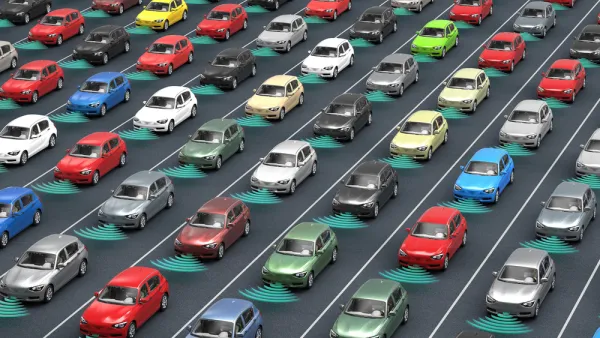
Can Autonomous Vehicles Absolve the Sins of 20th Century Planning?
Self-driving cars are likely to become part of the urban landscape in the future, and they have the potential to drastically alter urban environments—in good and bad ways.

Self-Driving Cars Hog Power
Self-driving cars process a tremendous amount of data to pilot themselves through crowded streets. That computing power needs electricity, and lots of it.
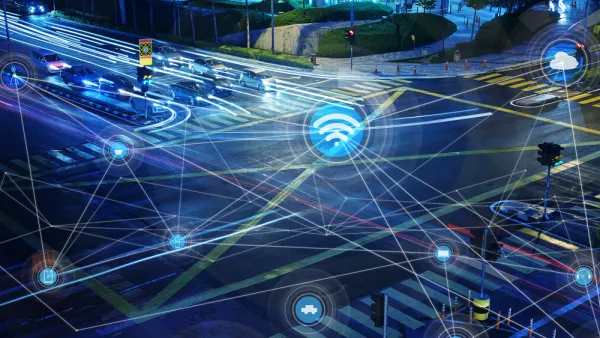
The Many Problems With Autonomous Vehicles
Optimists predict that autonomous vehicles will be a transportation panacea, but there are good reasons to be skeptical. They may create as many problems as they solve.

Planetizen Federal Action Tracker
A weekly monitor of how Trump’s orders and actions are impacting planners and planning in America.

Amtrak, CN end decades-long dispute with eight-year agreement
The new operating agreement establishes an updated framework for the companies to work together, including processes to resolve disputes.

Northwest rail fans eager for Sept. 30 debut of Amtrak’s Airo fleet
Get ready for that new train smell and more seats. But they won’t go faster or run more frequently on the Cascades route in Washington and Oregon.

NYC to turn city-owned property into thousands of homes
The city has scheduled a public hearing regarding the development for October.

Buses travel at 5mph along this route in NYC. The Bronx's first-ever busway looks to change that
Prior to the busway, buses on the Bx36 route traveled as slowly as 5 miles per hour.

Pittsburg launches 'EZ permits,' aims for one-day turnaround for low-risk permits
The pilot ‘fast lane’ for permits is part of a bundle of modernization efforts for Pittsburg’s permitting process.

FREE Course: Walkable City 1: Why Walkability?
After describing his path towards focusing on walkability as the essence of good planning, Jeff Speck marches through his five principal reasons for making more walkable places.
Reinventing Malls: Planning Alchemy—Turning Gray Fields Into Gold
The course focuses on the opportunities and imperatives that shape reinvention of mall sites.

City of Thousand Oaks
City of Wisconsin Rapids
Harvard University Graduate School of Design
The Architects Foundation
University of Cincinnati Online
The Pocatello Development Authority
The Urban Renewal Agency of the City of Pocatello

