A new report from the Centers for Disease Control and Prevention shows a 'broad decline' in childhood obesity rates among poor children in the United States. Could the country be turning a corner in its battle against childhood obesity?


"The obesity rate among young children from poor families fell in 19 states and U.S. territories in recent years, federal health officials said Tuesday, the first major government report showing a consistent pattern of decline for low-income children," reports Sabrina Tavernise.
"The cause of the decline remains a mystery, but researchers offered various theories, like an increase in breastfeeding and a drop in calories from sugary drinks," she adds. "In interviews, parents suggested that they have become more educated in recent years, and so are more aware of the health issues associated with being overweight."
"Researchers last analyzed these data in 2009, when only 9 states had obesity declines and 24 had increases. In the report on Tuesday, the proportions were reversed, with only 3 states experiencing increases and 19 showing declines; 20 states and Puerto Rico were flat."
Read the full story: Broad Decline in Obesity Rate Seen in Poor Young Children
Fighting Food Deserts in Los Angeles
Public health analysts and justice activists are tackling food deserts in a state known for its agricultural output. Low-income neighborhoods of color are the hardest hit by a lack of grocery options.
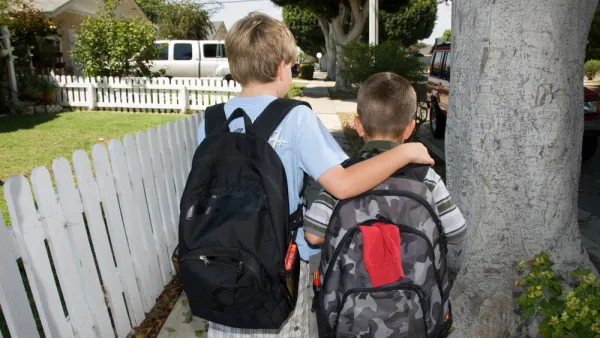
Let Our Children Walk
Many Americans believe children should not be free to walk alone, because of crime and traffic. But children constantly driven around by their parents or locked away at home are also subject to significant risks.
Why Walkability is a Civil Rights Issue
The NAACP is probably not the first advocacy group you think of when it comes to supporting walking and biking. But the civil rights organization encourages increasing physical activity in minority communities to help reduce childhood obesity.

Desperate measures: Advocates weigh draining Lake Powell to fill Colorado River
Draining the reservoir could reduce evaporation losses by a couple hundred thousand acre-feet.

Eastern Nebraska is running out of electricity
Data centers and electrification are straining eastern Nebraska’s grid, throttling economic development.

Malls are becoming the midtowns of the future
Mall and office park redevelopments are a generational opportunity to create new nodes of urbanity.

NYC breaks ground on anti-flooding infrastructure project
New York City's new system will reduce stormwater flows to local sewers by 90%.

One Kentucky town’s secret to affordable housing
The Smoketown Community Land Trust has already built seven affordable homes for community members.

Houston gains petal-shaped cooling infrastructure to make streets more ‘delightful’
The city has installed the pavilions along 15 blocks in Houston.

FREE Course: Walkable City 1: Why Walkability?
After describing his path towards focusing on walkability as the essence of good planning, Jeff Speck marches through his five principal reasons for making more walkable places.
Reinventing Malls: Planning Alchemy—Turning Gray Fields Into Gold
The course focuses on the opportunities and imperatives that shape reinvention of mall sites.

City of Rosemead
Rutgers University, Edward J. Bloustein School of Planning and Public Policy
One Hundred Miles
University of Michigan School for Environment and Sustainability (SEAS)
Hunter College, City University of New York (CUNY)
The Architects Foundation
City of Cambridge
Montrose County
The Pocatello Development Authority