As calls for reforming California's oft-abused environmental law increase, opponents are digging in their heels in anticipation of Governor Jerry Brown's effort to revise the law to ease approval processes, reports Evan Halper.


Completing a trade trip to China, in which the country's ability to complete large infrastructure projects such as high-speed rail were contrasted with the Governor's difficulties to do the same at home, Jerry Brown addressed the prognosis for CEQA reform.
"A pillar of his plan to let the 'bulldozers roll' on big projects in California has been an overhaul of the state's landmark environmental law, which can tangle development in litigation for years," writes Halper. "Yet before he even boarded his return flight, the governor said he was giving up on any substantial revision this year of the 40-year-old law, which he says stands in the way of progress."
"The appetite for such change 'is bigger outside the state Capitol than it is inside,' Brown said as he sipped tea in the southern port city of Shenzhen on his last full day of events abroad. 'This is not something you get done in a year. There are very powerful forces that are strong in the [Democratic] Party that will resist.'"
"The law 'has turned into something it was never intended to be,' said Matt Regan, vice president of the Bay Area Council, a business advocacy group promoting changes in the law. 'The bulk of CEQA lawsuits filed by labor are not for environmental purposes.'"
"But unions are not the only ones abusing this law," he continued. "Businesses do it. NIMBYs do it. It has become the default for people who want to stop anything."
Read the full story: Jerry Brown starts push to revamp California's environmental law


California Adopts CEQA Reforms for Infrastructure, Leaves Out Residential
The state of California adopted reforms to the California Environmental Quality Act (CEQA) pertaining to climate-friendly infrastructure projects, but residential development interests hoping for relief from CEQA will have to wait.
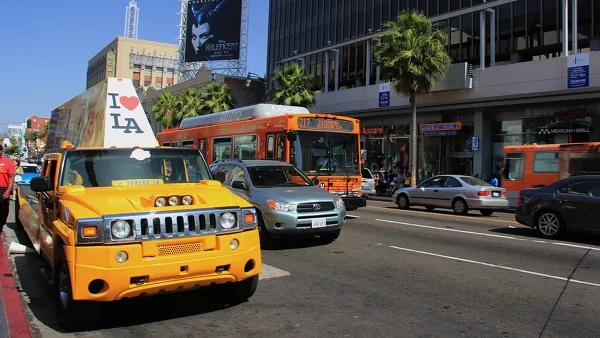
Level of Service Canceled in Los Angeles
The Los Angeles City Council voted to officially end the use of Level of Service in measuring environmental impact in favor of a more people-friendly measure: vehicle miles traveled.
A New Day for the California Environmental Quality Act
The California Natural Resources Agency posted the final version of amendments to the California Environmental Quality Act, enabled by 2013's SB 743, at the end of 2018.

Planetizen Federal Action Tracker
A weekly monitor of how Trump’s orders and actions are impacting planners and planning in America.

Amtrak, CN end decades-long dispute with eight-year agreement
The new operating agreement establishes an updated framework for the companies to work together, including processes to resolve disputes.

Judges permit Denver to divert 77,000 acre feet from the Colorado River for reservoir expansion
Overuse and climate change have caused the Colorado River’s water levels to plummet.

NYC DOT wants faster, more permanent street upgrades
The city is examining ways to build more concrete infrastructure without getting entangled in 'decades-long' projects.

'Something we’ve never seen before:' rising utility rates could strain city finances nationwide
Data centers, climate change and other factors have caused utility rates in the United States to increase by 38% since 2020.

Trump to overrule local leaders, lease millions of acres of America’s Pacific Island territories’ seafloors to mining companies
International law says that the Indigenous people of America’s territories have a right to prior and informed consent regarding projects that impact their countries.

FREE Course: Walkable City 1: Why Walkability?
After describing his path towards focusing on walkability as the essence of good planning, Jeff Speck marches through his five principal reasons for making more walkable places.
Reinventing Malls: Planning Alchemy—Turning Gray Fields Into Gold
The course focuses on the opportunities and imperatives that shape reinvention of mall sites.

Harvard University Graduate School of Design
KFH Group Inc.
Greater Baltimore Committee
The Architects Foundation
University of Cincinnati Online
The Pocatello Development Authority
The Urban Renewal Agency of the City of Pocatello