Philadelphia's award winning police headquarters, called "the Roundhouse", has received a belated 50th birthday present: the threat of demolition.


Nicole Anderson brings news that the Brutalist "Roundhouse", designed by architectural firm, Geddes, Brecher, Qualls, and Cunningham (GBQC), and recipent of the American Institute of Architects’ Gold Medal Award for Best Philadelphia Architecture in 1963, has become the latest icon from the controversial period of architectural history to face an uncertain future. With the city planning to relocate the police department to a renovated building on Market Street, Mayor Nutter has announced plans to sell the unique building, with the site having been previously identified as likely for redevelopment.
Philadelphia's design and preservation community isn't taking the threat lying down, however. "Right now, graduate students at the University of Pennsylvania’s Historic Preservation Graduate Program have teamed up with Georgia Institute of Technology’s School of Architecture to come up with different reuse strategies for the Roundhouse," says Anderson. "Two graduate students at UPenn, Kimber VanSant and Allee Berger, have launched a campaign, Save the Roundhouse, on Facebook."
In a column last month, the Philadelphia Inquirer's architectural critic Inga Saffron argued for the building's design merits. "With its sinuous, double-barreled profile, washboard abs and sculptural details, it has real style, which is more than you can say for many of today's bland, glass towers," she opined. "Our eyes and taste change. You might not like the Roundhouse now. But I predict you will - assuming it survives."
"Berger and VanSant plan on pursuing landmark status for the building," adds Anderson, "but fear that with a backlog of nominations waiting for approval at the Philadelphia Historical Commission, time might run out before the city’s development gets underway. The two preservationists are also concerned that city officials have misrepresented the condition of the building."
Read the full story: Pending Sale of Philadelphia’s Roundhouse Police Headquarters Spurs Campaign for Landmark Status

Learning loss and urban schools, part 2
Did test scores in progressive cities drop more post-COVID than test scores in moderate ones?
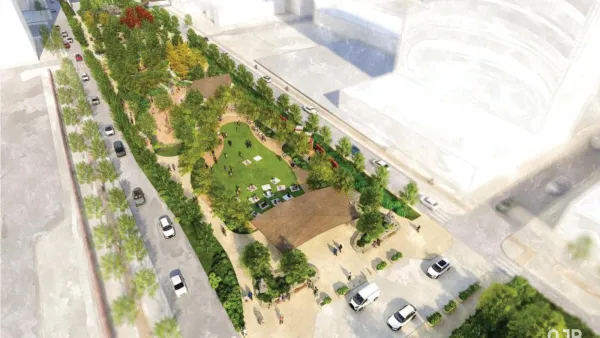
Philadelphia lawmakers fight to save 'Chinatown Stitch' from Trump cuts
The freeway cap project, approved and funded under the Biden administration, is now in jeopardy after the federal government rescinded all but $8 million in funding.
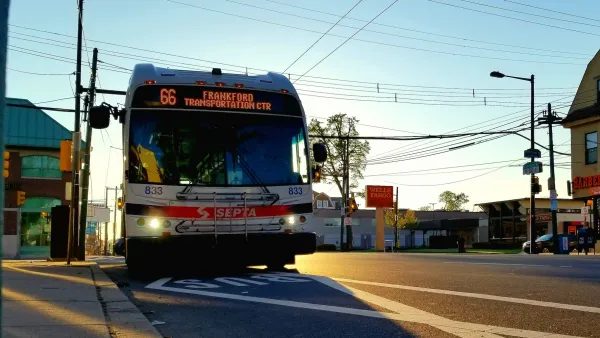
SEPTA's bus-mounted lane enforcement cameras cut travel times by up to 6%
The AI-assisted cameras have issued nearly 200,000 citations to drivers blocking bus lanes.

Planetizen Federal Action Tracker
A weekly monitor of how Trump’s orders and actions are impacting planners and planning in America.

Eastern Nebraska is running out of electricity
Data centers and electrification are straining eastern Nebraska’s grid, throttling economic development.

Study reveals best places in the U.S. for cycling, walking
New research from Streetlight Data examines bicycle and pedestrian miles per capita in the 100 largest U.S. cities by population.

DSA members accuse Mamdani of 'abandoning values' over housing redevelopment
New York City's mayor plans to replace about 2,000 units of public housing with private, mixed-income housing.

All sides of BRT debate unhappy with CDOT’s most recent move
The Colorado Department of Transportation is no longer considering center-running bus lanes for Colorado Boulevard.

Massachusetts bogs generate both power, and cranberries
Putting solar panels above farmland is one way Massachusetts is advancing toward its goal of net-zero carbon emissions by 2050.

FREE Course: Walkable City 1: Why Walkability?
After describing his path towards focusing on walkability as the essence of good planning, Jeff Speck marches through his five principal reasons for making more walkable places.
Reinventing Malls: Planning Alchemy—Turning Gray Fields Into Gold
The course focuses on the opportunities and imperatives that shape reinvention of mall sites.

City of Rosemead
Rutgers University, Edward J. Bloustein School of Planning and Public Policy
One Hundred Miles
University of Michigan School for Environment and Sustainability (SEAS)
Hunter College, City University of New York (CUNY)
The Architects Foundation
City of Cambridge
The Pocatello Development Authority
The Urban Renewal Agency of the City of Pocatello