Mumbai architect Pallavi Shrivastava reflects on the impact that the inaccessibility of the city has on the status of women in society and their ability to shape the future of the places in which they live.


Access to public space in cities like Mumbai is a privilege that many men likely take for granted. The threat of reprehensible behavior facilitated by planned and unplanned urban spaces forces women to devise "their own compromised mode of urban movement," writes Shrivastava, and ultimately limits their role in society.
"The very idea that women can be out in open urban spaces on their own is not a given in a society where paternalism is so often implicit in even the most well-meaning advice. It is unsurprising that we do not see many women in leadership roles here. With such a deeply ingrained habit of treating women as dependent, and therefore secondary citizens, how does India intend to provide equal access to urban spaces outside their homes?"
"We need to make the city unequivocally a place of belonging, exploration and enjoyment," she argues. "Functional infrastructure in the form of safe public transport, toilets, well-lit streets, and safe urban spaces remains at the core of the issue. But access to public spaces like promenades, beaches, sidewalks, parks, libraries, and running tracks are already required of a well-designed and inclusive city irrespective of gender, sexual orientation, ethnicity or economic class."
"It is our public spaces that communicate a city's attitude towards its citizens. The presence of well-designed infrastructure and inviting places are a measure of its inclusiveness. Can we design urban spaces that are sensitive to everybody?"
Read the full story: A woman's right to enjoy the city


As Temperatures Increase, Maps Show Sea-Level Rise Will Devastate Cities
Data visualizations illustrate the catastrophic consequences of single-digit global temperature increases.
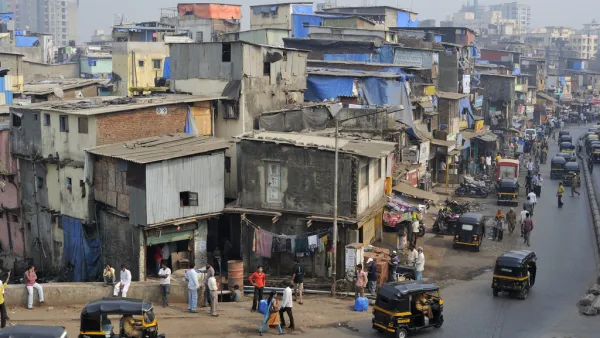
Allowing Higher Density to Fix Slums
Despite its economic dynamism, Mumbai is known for a lack of adequate housing. Citywide increases to maximum Floor Space Indices (i.e., Floor Area Ratios) will increase living space per resident, provided the right redevelopment takes place.
Can Transit Oriented Development be Effective in India?
TOD as a planning tool is new to Indian cities, where the idea is being championed as a solution to congestion, environment quality and housing equity. Can this concept, developed for the North American city, be successful in Indian cities?

Planetizen Federal Action Tracker
A weekly monitor of how Trump’s orders and actions are impacting planners and planning in America.

Amtrak, CN end decades-long dispute with eight-year agreement
The new operating agreement establishes an updated framework for the companies to work together, including processes to resolve disputes.

Judges permit Denver to divert 77,000 acre feet from the Colorado River for reservoir expansion
Overuse and climate change have caused the Colorado River’s water levels to plummet.

Philadelphia to invest $2 billion into upgrading city airports as PHL places last in customer satisfaction
Modernizations to Philadelphia's airports will include baggage system upgrades and a new automated parking garage guidance system.

The LA housing policies making developers turn away from the city
Despite LA’s housing shortage, developers say the city’s "mansion-tax" and pandemic-era policies make it an unappealing place to build housing.

New density bill would require 7 California cities to establish regional transit hubs
The bill would also require major cities in California to permit high-rise residential buildings.

FREE Course: Walkable City 1: Why Walkability?
After describing his path towards focusing on walkability as the essence of good planning, Jeff Speck marches through his five principal reasons for making more walkable places.
Reinventing Malls: Planning Alchemy—Turning Gray Fields Into Gold
The course focuses on the opportunities and imperatives that shape reinvention of mall sites.

City of Wisconsin Rapids
Harvard University Graduate School of Design
KFH Group Inc.
The Architects Foundation
University of Cincinnati Online
The Pocatello Development Authority
The Urban Renewal Agency of the City of Pocatello