Although young adults and baby boomers are flocking back to America's cities, declines in K-12 enrollment are causing many cities to close their schools. A new report looks at the commons challenges in finding new uses for these buildings.


looks at a new report [PDF] from The Pew Charitable Trusts that examines how 12 urban school districts across the country are managing their "growing inventory of empty and shuttered buildings that are difficult to sell, lease, or otherwise repurpose..."
"Though there is wide variability among district's real estate markets or local policies around the reuse of school buildings, they all face common challenges when trying to find new life for surplus buildings, the Pew report found. Chief among them:
- Size—School buildings are big. Most of them exceed 50,000 square feet and are not well-suited for other types of enterprises;
- Age—The typical building is more than 60 years old and some are as old as 100 years, making them costly to refurbish and update for modern use;
- Location—Many shuttered buildings are in neighborhoods where the residential population is shrinking and real estate values are already low."
In deciding what to do with shuttered schools, cities are often left with a series of bad options, including: demolishing them, holding onto them indefinitely (and incurring costs in insuring, maintaining, and securing them), or selling them ("usually at a lower price than projected").
According to Maxwell, "The shutdown of schools in cities has triggered a loud and growing backlash recently and prompted parent and student groups in several cities to call for a moratorium on closures and to file formal complaints with civil rights officials in the U.S. Department of Education."
Read the full story: Urban Districts Struggle to Sell Shuttered Schools, Report Finds

Could Vacant Schools Help Meet Philly's Affordable Housing Needs?
In Philadelphia, and other cities going through demographic changes, shuttered schools provide a challenge and opportunity for redevelopment and reuse. Two board members of the Pennsylvania Housing Finance Agency (PHFA) offer a creative solution.

Philadelphia lawmakers fight to save 'Chinatown Stitch' from Trump cuts
The freeway cap project, approved and funded under the Biden administration, is now in jeopardy after the federal government rescinded all but $8 million in funding.
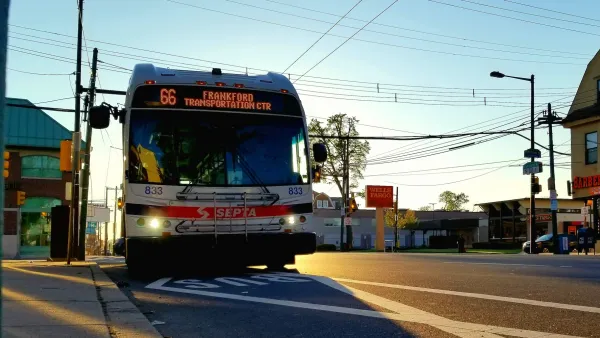
SEPTA's bus-mounted lane enforcement cameras cut travel times by up to 6%
The AI-assisted cameras have issued nearly 200,000 citations to drivers blocking bus lanes.

Planetizen Federal Action Tracker
A weekly monitor of how Trump’s orders and actions are impacting planners and planning in America.

Amtrak, CN end decades-long dispute with eight-year agreement
The new operating agreement establishes an updated framework for the companies to work together, including processes to resolve disputes.

Northwest rail fans eager for Sept. 30 debut of Amtrak’s Airo fleet
Get ready for that new train smell and more seats. But they won’t go faster or run more frequently on the Cascades route in Washington and Oregon.

Brightline Florida files for bankruptcy
The transit company is over $5 billion in debt.

St. Louis Metro to test if single-car trains can reduce operating costs, maintain rider satisfaction
The pilot program will run from October to spring 2027, and begin with one single-car train operating on Metrolink’s Red and Blue lines.

Pennsylvania is building data centers in abandoned mines
Housing data centers in mines provides an alternative to destroying local forests and may spare residents from data centers’ noise and air pollution.

FREE Course: Walkable City 1: Why Walkability?
After describing his path towards focusing on walkability as the essence of good planning, Jeff Speck marches through his five principal reasons for making more walkable places.
Reinventing Malls: Planning Alchemy—Turning Gray Fields Into Gold
The course focuses on the opportunities and imperatives that shape reinvention of mall sites.

City of Thousand Oaks
City of Wisconsin Rapids
Harvard University Graduate School of Design
The Architects Foundation
University of Cincinnati Online
The Pocatello Development Authority
The Urban Renewal Agency of the City of Pocatello