With college bowl season well underway (and reaching its climax on Monday) and the NFL playoffs starting this weekend, football fever is sweeping America. Richard Florida looks at which cities can boast the most rabid fan bases.


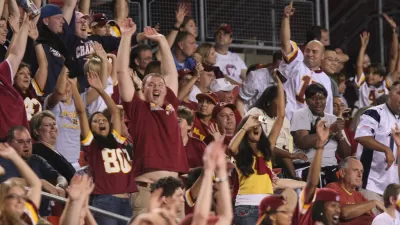
The most popular sport in America doesn't cater to a niche audience. Florida reports that, "[a] 2010 survey found that roughly two-thirds of Americans watch professional football, compared to just over half for college." And with last Sunday's Cowboys-Redskins broadcast on NBC earning the highest television ratings of the year for any program since the Academy Awards telecast (not including the London Olympics), it's clear that football means big business and big audiences.
To delve into the dynamics of football fandom, Florida and Patrick Adler, a doctoral student in urban planning at UCLA, investigated which teams and cities have the most fanatical fans, and "how pro fans stack up against those who favor the college game on a city by city basis."
For overall average attendance, pro and college combined, the big metros come out on top (New York leads, followed by San Francisco and Dallas). In metros where only college football is played, Los Angeles, Ann Arbor, and Columbus top the list. When considering football attendance as a share of a metro's population, "much smaller metros rise to the top. Oxford and Starkville, Mississippi rank first and second. Both have attendance that exceeds 100 percent of their population — a figure that is bolstered by students and out of area commuters."
What accounts for the overwhelming popularity of football in smaller versus larger metros? Says Florida, "It makes sense, actually, that small towns would have a stronger support base for their college teams. Folks in bigger cities and metros have a lot of options for entertainment, but the options in smaller metros and college tons [sic] are more limited — making football the biggest game in town."
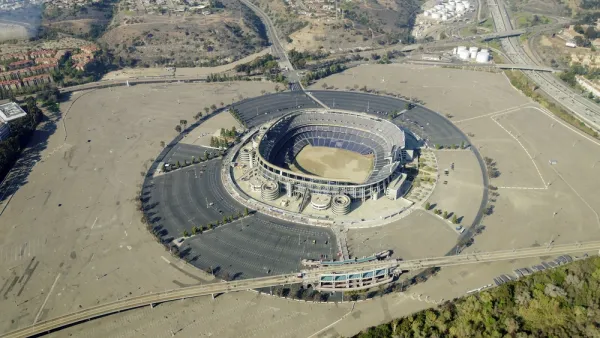
San Diego Mayor Supports New Football Stadium
San Diego mayor, Kevin Faulconer, calls for voters to support $1.8 billion new football stadium.

Bandwagon Residents: Does a Winning Football Team Fuel Urban Growth?
Some residents of Tuscaloosa, Alabama believe the University of Alabama football team's success on the field has directly contributed to the region's growth.
Is the Local NFL Team Hurting the Local College Team and the Local Economy?
Studies show building NFL stadiums drain tax revenues and don't boost local economies. What about NFL teams themselves? Land use attorney (and football fan) Bill Adams argues that they rob support from local college teams and local economies.

Desperate measures: Advocates weigh draining Lake Powell to fill Colorado River
Draining the reservoir could reduce evaporation losses by a couple hundred thousand acre-feet.

Eastern Nebraska is running out of electricity
Data centers and electrification are straining eastern Nebraska’s grid, throttling economic development.

Move over, LA: St. Louis gears up for Olympics, invests millions in downtown redevelopment
The Missouri city will host the 2028 Olympic soccer group stage and knockout matches.

Mass. votes against statewide minimum lot size for single-family homes
Over 2 million residents voted on Question 7; it was decided by just over 30,000 votes.

Maryland’s $15 billion bridge project gains key approval
The Maryland Transit Authority said the project will create over 60,000 jobs and add $23 billion to the local economy.

‘No clear next steps’ for Chicago's permanent festival grounds
Eleventh Ward Ald. Nicole Lee has suggested Soldier Field as a possible location for the permanent event space.

FREE Course: Walkable City 1: Why Walkability?
After describing his path towards focusing on walkability as the essence of good planning, Jeff Speck marches through his five principal reasons for making more walkable places.
Reinventing Malls: Planning Alchemy—Turning Gray Fields Into Gold
The course focuses on the opportunities and imperatives that shape reinvention of mall sites.

City of Rosemead
Rutgers University, Edward J. Bloustein School of Planning and Public Policy
One Hundred Miles
University of Michigan School for Environment and Sustainability (SEAS)
Hunter College, City University of New York (CUNY)
The Architects Foundation
City of Cambridge
Montrose County
The Pocatello Development Authority