As part of an endeavor to improve access to New York's 525 Privately Owned Public Spaces (POPS), which gained notoriety during last year's Occupy Wall Street protests, a new website has been launched to help the public find and utilize them.


Branden Klayko provides a description of the new POPS web portal, a joint project of the Municipal Arts Society (MAS) and Advocates for Privately Owned Public Space (APOPS), which endeavors to catalog each of the hundreds of POPS built in New York City as a result of a 1961 zoning resolution that granted zoning concessions to property owners in return for providing public space.
The mission of the website, which was launched in beta mode last week, is "to engage and inform the public by making data, photos, and site plans of the parks available in an easy-to-use format," says Klayko. "On the website, users can browse detailed information on each POPS location, learning about its amenities, history, and hours of access." Furthermore, "The public can participate in the project by ranking and commenting on POPS, making recommendations and announcements, posting photos, and reporting problems with the public spaces."
Says APOPS founder Jerold Kayden: "We're inviting the public to be our eyes and ears as a means to make these spaces more of an asset for everyone in the city. And to make people in other cities realize they can do the same thing."
Read the full story: POPS goes the Website
Contest: Design a Logo for New York's Privately-Owned Public Spaces
New York City is holding a competition for a distinctive logo to clearly demarcate all of its 550 privately-owned public spaces.

Making Privately Owned Public Spaces in New York City More Accessible by Mapping Them
A new map shows where privately owned public spaces are located to encourage more public use.
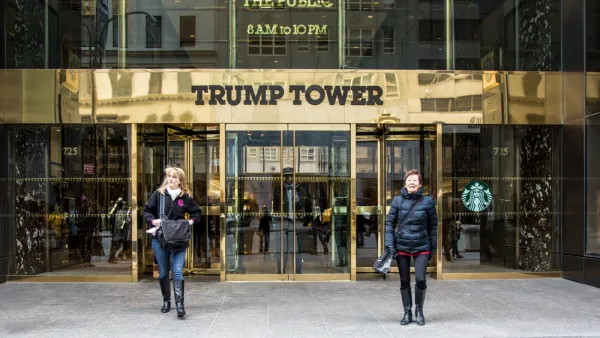
Report: Trump Tower Among Many NYC Buildings Not Maintaining Privately Owned Public Spaces
It's no secret that building owners often fail to maintain privately owned public spaces with any priority on the public part of that equation. A new report reveals just how widespread the problem is in New York.

Planetizen Federal Action Tracker
A weekly monitor of how Trump’s orders and actions are impacting planners and planning in America.

Eastern Nebraska is running out of electricity
Data centers and electrification are straining eastern Nebraska’s grid, throttling economic development.

Study reveals best places in the U.S. for cycling, walking
New research from Streetlight Data examines bicycle and pedestrian miles per capita in the 100 largest U.S. cities by population.

DSA members accuse Mamdani of 'abandoning values' over housing redevelopment
New York City's mayor plans to replace about 2,000 units of public housing with private, mixed-income housing.

All sides of BRT debate unhappy with CDOT’s most recent move
The Colorado Department of Transportation is no longer considering center-running bus lanes for Colorado Boulevard.

Massachusetts bogs generate both power, and cranberries
Putting solar panels above farmland is one way Massachusetts is advancing toward its goal of net-zero carbon emissions by 2050.

FREE Course: Walkable City 1: Why Walkability?
After describing his path towards focusing on walkability as the essence of good planning, Jeff Speck marches through his five principal reasons for making more walkable places.
Reinventing Malls: Planning Alchemy—Turning Gray Fields Into Gold
The course focuses on the opportunities and imperatives that shape reinvention of mall sites.

City of Rosemead
Rutgers University, Edward J. Bloustein School of Planning and Public Policy
One Hundred Miles
University of Michigan School for Environment and Sustainability (SEAS)
Hunter College, City University of New York (CUNY)
The Architects Foundation
City of Cambridge
The Pocatello Development Authority
The Urban Renewal Agency of the City of Pocatello