Darby Minow Smith profiles Katherine Gajewski, Director of Philadelphia's Office of Sustainability, and looks at the efforts she's leading to give vision to the next phase of the city's history.


With 300 years of compact development around the rational plan of William Penn, Philadelphia has great bones around which to build a sustainable city for the 21st century. And as the Director of the city's Office of Sustainability, it's Katherine Gajewski's responsibility to lead the effort to transform the way the city looks and works over the next 20 years, reports Smith. "Gajewski works to implement the ambitious city-wide Greenworks Philadelphia plan [PDF], directs a five-county energy-efficiency program, and even organizes a social group of city employees nicknamed the 'Young-ish City Government Workers.'"
"In 20 years, half of the city is going to be covered in green
infrastructure. That means everything from smart streets to parks and
open spaces to green roofs," says Gajewski. "We're only four years into our [sustainability] plan and already
people's perceptions of Philadelphia are changing. Our population is on
the rise. We have more people who are moving into the city."
Read the full story: Philadelphia’s Katherine Gajewski is turning a gritty city green


Swapping your gas car for an EV is greener than keeping it, research shows
An EV repays the 'carbon debt' caused by building it after 4,400 miles.

Climate change could double household water costs in some cities, study finds
New research suggests that climate change-related stressors are straining municipal water systems.
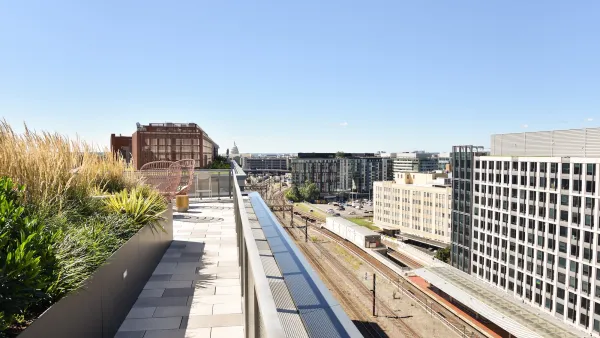
DC energy efficiency rule requires buildings to upgrade their infrastructure or face millions in fines
Building owners and condo co-op members say the upgrades are often prohibitively expensive.

Planetizen Federal Action Tracker
A weekly monitor of how Trump’s orders and actions are impacting planners and planning in America.

Amtrak, CN end decades-long dispute with eight-year agreement
The new operating agreement establishes an updated framework for the companies to work together, including processes to resolve disputes.

Judges permit Denver to divert 77,000 acre feet from the Colorado River for reservoir expansion
Overuse and climate change have caused the Colorado River’s water levels to plummet.

Boston has spent millions making the Green Line more accessible — and there’s no end in sight
While the city has invested millions into expanding and adding platforms to the Green Line to make it more accessible, new train cars set to arrive next year will be too tall for disabled passengers to board without raising the current platforms.

Idaho may see an 18% drop in federal surface transit funding — the largest estimated cut in the US
Transit systems in rural communities are much more reliant on federal funding to provide their services.

How ‘post-disaster gentrification’ alters neighborhoods after natural calamities
After hurricanes, fires or other calamities, the original residents of a community are often replaced by younger, wealthier residents.

FREE Course: Walkable City 1: Why Walkability?
After describing his path towards focusing on walkability as the essence of good planning, Jeff Speck marches through his five principal reasons for making more walkable places.
Reinventing Malls: Planning Alchemy—Turning Gray Fields Into Gold
The course focuses on the opportunities and imperatives that shape reinvention of mall sites.

Harvard University Graduate School of Design
KFH Group Inc.
Greater Baltimore Committee
The Architects Foundation
University of Cincinnati Online
The Pocatello Development Authority
The Urban Renewal Agency of the City of Pocatello