






















Rives Taylor pens an editorial for Urban Land advocating for "engineered resilience", which he describes as "next-generation sustainability" that "adds adaptability and the protection of human life" to planning for the well-being of the planet.


Taylor, a principal at Gensler, dives into the growing discussion over the concept of resilience amongst those in the planning and development community. He sees engineered resilience as the logical progression of sustainability to embrace, "climate uncertainty, predicted rises in sea level, and terrorism (all of
which have exposed deep vulnerabilities in our built environment and
infrastructure), as well as something exquisitely calculable: risk
management."
In his practice orchestrating sustainability and resilience planning for clients around the world, Taylor finds that "sustainability is morphing into resilience," with "companies
often redirecting their 'greening' costs to a broader program of
resilience." He regards the greatest challenge to those assisting clients with designing, developing, and operating redundant buildings, "is to keep resilience human, stopping well short of creating buildings and campuses that look and live like bomb shelters."
"That is exactly how engineered resilience should be approached-not by an
obvious 'hardening' and dehumanizing of a building, but by designing it
to be flexible and adaptable when put under stress," writes Taylor. "That is largely
done by designing multiple redundancies (also known as diversity) into
its critical systems for power and water, into a smart envelope, into
the site design, and into the building's connection to the community. If
one system or approach fails, another is designed to kick in, and
potentially another after that, as part of a well-choreographed response
to trouble-like a boxer bobbing and weaving to avoid a punch and remain
standing."
FULL STORY: Land Writes: Engineered Resilience


Rebuilding Smarter: How LA County Is Guiding Fire-Ravaged Communities Toward Resilience
Los Angeles County is leading a coordinated effort to help fire-impacted communities rebuild with resilience by providing recovery resources, promoting fire-wise design, and aligning reconstruction with broader sustainability and climate goals.

FEMA Resilience Program Cuts Grant Funding
The Building Resilient Infrastructure and Communities program funded projects from flood prevention to power station upgrades.

Advancing Sustainability in Los Angeles County Schools
The Los Angeles County Office of Education’s Green Schools Symposium brings together educators, students, and experts to advance sustainability in schools through innovative design, climate resilience strategies, and collaborative learning.

Maui's Vacation Rental Debate Turns Ugly
Verbal attacks, misinformation campaigns and fistfights plague a high-stakes debate to convert thousands of vacation rentals into long-term housing.

Planetizen Federal Action Tracker
A weekly monitor of how Trump’s orders and actions are impacting planners and planning in America.
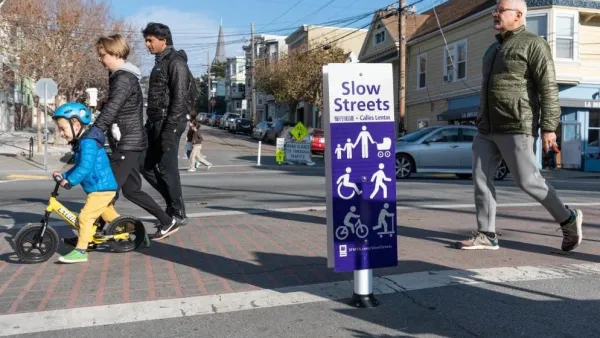
San Francisco Suspends Traffic Calming Amidst Record Deaths
Citing “a challenging fiscal landscape,” the city will cease the program on the heels of 42 traffic deaths, including 24 pedestrians.

Defunct Pittsburgh Power Plant to Become Residential Tower
A decommissioned steam heat plant will be redeveloped into almost 100 affordable housing units.

Trump Prompts Restructuring of Transportation Research Board in “Unprecedented Overreach”
The TRB has eliminated more than half of its committees including those focused on climate, equity, and cities.

Amtrak Rolls Out New Orleans to Alabama “Mardi Gras” Train
The new service will operate morning and evening departures between Mobile and New Orleans.

Urban Design for Planners 1: Software Tools
This six-course series explores essential urban design concepts using open source software and equips planners with the tools they need to participate fully in the urban design process.
Planning for Universal Design
Learn the tools for implementing Universal Design in planning regulations.

Heyer Gruel & Associates PA
JM Goldson LLC
Custer County Colorado
City of Camden Redevelopment Agency
City of Astoria
Transportation Research & Education Center (TREC) at Portland State University
Jefferson Parish Government
Camden Redevelopment Agency
City of Claremont