In an initiative announced today, New York will become the first city in the U.S. to test social impact bonds, "an experimental mechanism for financing social services that has excited and worried government reformers around the world."


David Chen reports on New York City's first-in-the-nation experiment with "social-impact bonds", also called pay-for-success bonds, which have already been tested in Britain and Australia and are gaining fans in the United States from governments searching for new ways to finance human-services programs.
In the program announced today, "Goldman Sachs will provide a $9.6 million loan to pay for a new
four-year program intended to reduce the rate at which adolescent men
incarcerated at Rikers Island reoffend after their release," writes Chen. If the program hits certain targets, Goldman could make a tidy profit of $2.1 million; if it falls short, the financial services giant could lose $2.4 million.
"The money is not a huge amount for Goldman, which last month reported over $900 million in second-quarter profit,
and the investment promises a public-relations benefit for the Wall
Street bank. For the city, the money allows the Bloomberg administration
to demonstrate, and test, several of its priorities: enlisting private
sector help in financing public needs, and tying program money to
rigorous outcome evaluations," notes Chen.
"This promising financing model has potential to transform the way
governments around the country fund social programs, and as first in the
nation to launch it, we are anxious to see how this bold road map for
innovation works," Mr. Bloomberg said in a statement.
"Social impact bonds have potential upside for investors," he added,
"but citizens and taxpayers stand to be the biggest beneficiaries."
Read the full story: Goldman to Invest in City Jail Program, Profiting if Recidivism Falls Sharply
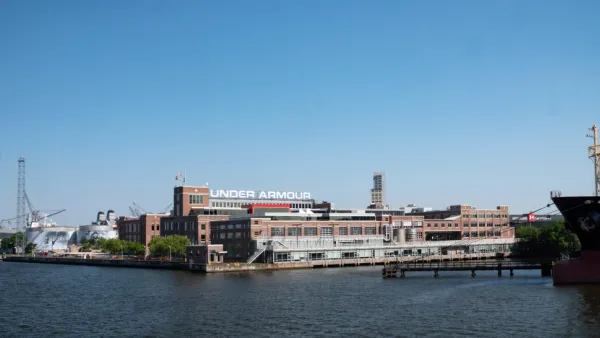
A $5.5 Billion Waterfront Plan for Baltimore Wins Opportunity Zone Status
The Port Covington plan was already in line to receive massive subsidies from the city of Baltimore. Now the plan will be the beneficiary of the new federal Opportunity Zone program as well.
How Social Impact Bonds Close the Funding Gap
The number of social impact bond programs in the United States has expanded quickly, to eight, with examples found in Massachusetts, New York, Ohio, Utah, and, now, California.
Social Impact Bonds Aim to Attract Investment in Public Health
A pilot project hopes to pioneer a new type of investment by alleviating asthma among lower-income children. Project developers hope the Fresno Asthma Impact Model could become a national model for improving health and reducing costs.

Planetizen Federal Action Tracker
A weekly monitor of how Trump’s orders and actions are impacting planners and planning in America.

California plans to bury El Niño’s downpour
If the state plays its cards right, it may be able to store a billion acre-feet of El Niño’s water in aquifers.

Desperate measures: Advocates weigh draining Lake Powell to fill Colorado River
Draining the reservoir could reduce evaporation losses by a couple hundred thousand acre-feet.

Los Angeles just elected an urban planner as its mayor
Transportation analysts are optimistic that Raman will be more aggressive in addressing transit issues than Bass.

Mamdani’s pied-à-terre tax survives legal challenge
A panel of judges found that the plaintiffs failed to demonstrate injury as a result of New York City's implementation of the tax.

Eastern Nebraska is running out of electricity
Data centers and electrification are straining eastern Nebraska’s grid, throttling economic development.

FREE Course: Walkable City 1: Why Walkability?
After describing his path towards focusing on walkability as the essence of good planning, Jeff Speck marches through his five principal reasons for making more walkable places.
Reinventing Malls: Planning Alchemy—Turning Gray Fields Into Gold
The course focuses on the opportunities and imperatives that shape reinvention of mall sites.

City of Rosemead
Rutgers University, Edward J. Bloustein School of Planning and Public Policy
One Hundred Miles
University of Michigan School for Environment and Sustainability (SEAS)
Hunter College, City University of New York (CUNY)
The Architects Foundation
City of Cambridge
Montrose County
The Pocatello Development Authority