An award-winning master plan for Toronto's Lower Don Lands, completed only five years ago by Michael Van Valkenburgh Associates, may be gutted if the Ford administration has its way, reports Alex Ulam.


As recently as last September, the mixed use master plan, "which was chosen as one of 16 founding projects of a Clinton Climate
Initiative," fended off attempts by Mayor Rob Ford and his brother, City Councillor Doug Ford, "to build a tourist-oriented
development on the site that would have featured a megamall and a Ferris
wheel."
Now comes news that the river reclamation and development plan for the 308-acre industrial section of Toronto's waterfront is facing a new assault. According to Ulam, "critics charge that the Ford administration is working on another
attempt to gut the 2007 Van Valkenburgh master plan, this time in
conjunction with Waterfront Toronto," the joint federal, provincial and municipal development agency in charge of developing the city's waterfront.
Signals point to a new approach to the site that will, "do the minimum we have to for flood
proofing in the form of an engineered channel; strip out what, in their
view, is all of the extra parkland; and put the land on the market for
developers," said Ken Greenberg, a prominent Toronto-based urban planner who worked on the Van Valkenburgh master plan.
"Officials with Waterfront Toronto counter that they are not, in fact,
changing the objectives of the Van Valkenburgh plan, but rather
developing new ideas about how to finance it."
Read the full story: Flow With It
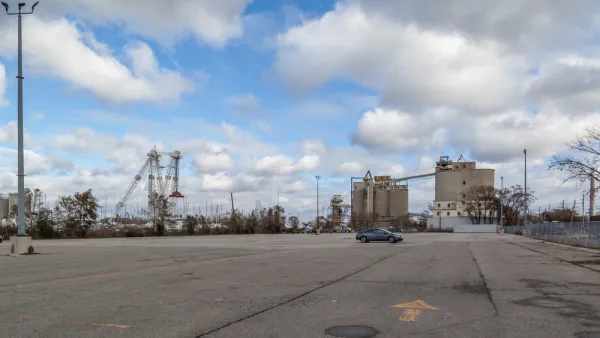
After Sidewalk Labs, a New Plan Emerges for Toronto's Waterfront
Just shy of a year after Sidewalk Labs pulled the plug on its "smart city" experiment for Quayside, Waterfront Toronto has a released a request for qualifications to move forward with a new, "people-centered" vision for the waterfront.

Decision on Sidewalk Labs' Plan for Toronto Waterfront Delayed
The spread of the coronavirus has delayed one of the most closely watched planning projects in North America.
Waterfront Toronto Greenlights Most of Sidewalk Labs' Quayside Master Plan
An evaluation committee made up of Waterfront Toronto staff has given a green light for the Sidewalk Labs master plan for Toronto to proceed to the next stages of planning.
Planetizen Federal Action Tracker
A weekly monitor of how Trump’s orders and actions are impacting planners and planning in America.

Eastern Nebraska is running out of electricity
Data centers and electrification are straining eastern Nebraska’s grid, throttling economic development.

Study reveals best places in the U.S. for cycling, walking
New research from Streetlight Data examines bicycle and pedestrian miles per capita in the 100 largest U.S. cities by population.

DSA members accuse Mamdani of 'abandoning values' over housing redevelopment
New York City's mayor plans to replace about 2,000 units of public housing with private, mixed-income housing.

All sides of BRT debate unhappy with CDOT’s most recent move
The Colorado Department of Transportation is no longer considering center-running bus lanes for Colorado Boulevard.

Massachusetts bogs generate both power, and cranberries
Putting solar panels above farmland is one way Massachusetts is advancing toward its goal of net-zero carbon emissions by 2050.

FREE Course: Walkable City 1: Why Walkability?
After describing his path towards focusing on walkability as the essence of good planning, Jeff Speck marches through his five principal reasons for making more walkable places.
Reinventing Malls: Planning Alchemy—Turning Gray Fields Into Gold
The course focuses on the opportunities and imperatives that shape reinvention of mall sites.

City of Rosemead
Rutgers University, Edward J. Bloustein School of Planning and Public Policy
One Hundred Miles
University of Michigan School for Environment and Sustainability (SEAS)
Hunter College, City University of New York (CUNY)
The Architects Foundation
City of Cambridge
The Pocatello Development Authority
The Urban Renewal Agency of the City of Pocatello