From lawsuits to development pressures, Landmarks Illinois, the venerable voice for preservation in the state, has been doing its best to fend off challengers to the state's historic treasures. A new president hopes to help stiffen the defenses.


Christopher Bentley surveys the challenging landscape facing Bonnie McDonald, as the current executive director of the Preservation Alliance of Minnesota prepares to take the reins of Landmarks Illinois. "Amid an ongoing legal battle over Chicago's landmarks law, a growing list of endangered buildings and a gaping state budget deficit, the new president of Landmarks Illinois has her work cut out for her," notes Bentley.
McDonald will have plenty of solid statistics behind her as she makes the case for the economic value of historic preservation. According to Bentley, "A Rutgers University study found nonresidential historic rehabilitation in Florida created on average 29 jobs per million dollars of initial investment by the state, compared to just 22 for electronics manufacturing or 13 for aircraft machinery production. Working for the state of Nebraska, the same group-Rutgers' Center for Urban Policy Research-affirmed that finding, noting that nationwide commercial historic rehabilitation could create 25 jobs for every million dollars invested.
In addition, McDonald will have her own experiences with the economic development and job creating power of adaptive reuse to rely on: "a 20 percent state tax credit for historic rehabilitation generated $9.20 in economic activity for every dollar in tax relief, according to a study by the University of Minnesota Extension Center for Community Vitality that McDonald's Preservation Alliance of Minnesota forwarded to lawmakers last year."
With the challenges facing preservation in Illinois, it sounds like McDonald will need all the help she can get.
Read the full story: Making the Case

Officials claim feds 'rushed' Amtrak environmental review
Amtrak plans to move their Chicago maintenance facility from an industrial area to a residential one.

‘No clear next steps’ for Chicago's permanent festival grounds
Eleventh Ward Ald. Nicole Lee has suggested Soldier Field as a possible location for the permanent event space.
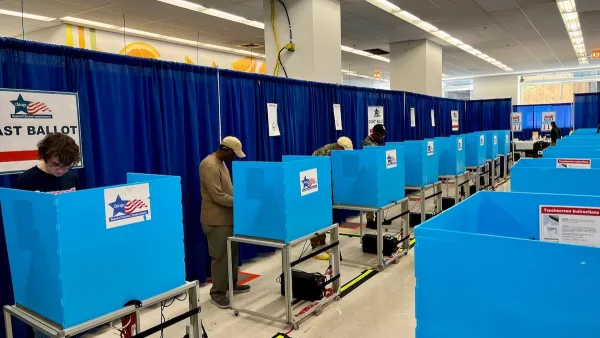
Chicago voters approve permanent festival grounds, penalty for vacant property owners
Currently, major summer and fall festivals take over public parks for weeks at a time, drawing criticism from nearby residents

Planetizen Federal Action Tracker
A weekly monitor of how Trump’s orders and actions are impacting planners and planning in America.

Eastern Nebraska is running out of electricity
Data centers and electrification are straining eastern Nebraska’s grid, throttling economic development.

Study reveals best places in the U.S. for cycling, walking
New research from Streetlight Data examines bicycle and pedestrian miles per capita in the 100 largest U.S. cities by population.

DSA members accuse Mamdani of 'abandoning values' over housing redevelopment
New York City's mayor plans to replace about 2,000 units of public housing with private, mixed-income housing.

All sides of BRT debate unhappy with CDOT’s most recent move
The Colorado Department of Transportation is no longer considering center-running bus lanes for Colorado Boulevard.

Massachusetts bogs generate both power, and cranberries
Putting solar panels above farmland is one way Massachusetts is advancing toward its goal of net-zero carbon emissions by 2050.

FREE Course: Walkable City 1: Why Walkability?
After describing his path towards focusing on walkability as the essence of good planning, Jeff Speck marches through his five principal reasons for making more walkable places.
Reinventing Malls: Planning Alchemy—Turning Gray Fields Into Gold
The course focuses on the opportunities and imperatives that shape reinvention of mall sites.

City of Rosemead
Rutgers University, Edward J. Bloustein School of Planning and Public Policy
One Hundred Miles
University of Michigan School for Environment and Sustainability (SEAS)
Hunter College, City University of New York (CUNY)
The Architects Foundation
City of Cambridge
The Pocatello Development Authority
The Urban Renewal Agency of the City of Pocatello