























As cities increasingly turn to automated systems to maximize cost and efficiency, Will Doig asks who should man the controls.


As cities and technology companies increase their efforts to gather, analyze, and utilize the data inherent in "a trillion connected and instrumented things", from cars and appliances to roadways and pipelines, Doig sees the smart-city movement at a major crossroads.
Along one path is a model of top-down control being pursued by technology companies such as IBM and Cisco who are "going all-in on smart cities, with designs that supposedly do everything from end traffic jams to prevent disease outbreaks to eliminate litter...Indeed, the goal of these companies is not just to participate in the evolution of smart cities, but to connect and control virtually everything with massive operating systems that will run these cities in their entirety."
Another path utilizes the bottom-up and open source potential of "maximizing the urban interface" amongst citizens their governments. Such an approach is reflected in technologies like SeeClickFix, "an online platform that lets people report local infrastructure problems, from leaky hydrants to dangerous intersections."
Although Doig asks which of these futures smart cities should shoot for, there are clearly advantages and challenges to each, and both are likely to guide the ways our cities work in the coming decades.
FULL STORY: Your next mayor: A computer


Planetizen Federal Action Tracker
A weekly monitor of how Trump’s orders and actions are impacting planners and planning in America.
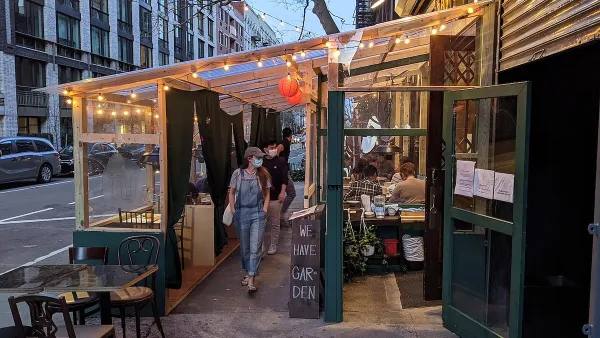
Restaurant Patios Were a Pandemic Win — Why Were They so Hard to Keep?
Social distancing requirements and changes in travel patterns prompted cities to pilot new uses for street and sidewalk space. Then it got complicated.

Map: Where Senate Republicans Want to Sell Your Public Lands
For public land advocates, the Senate Republicans’ proposal to sell millions of acres of public land in the West is “the biggest fight of their careers.”

Orange County, Florida Adopts Largest US “Sprawl Repair” Code
The ‘Orange Code’ seeks to rectify decades of sprawl-inducing, car-oriented development.

Maui's Vacation Rental Debate Turns Ugly
Verbal attacks, misinformation campaigns and fistfights plague a high-stakes debate to convert thousands of vacation rentals into long-term housing.

San Francisco Suspends Traffic Calming Amidst Record Deaths
Citing “a challenging fiscal landscape,” the city will cease the program on the heels of 42 traffic deaths, including 24 pedestrians.

Urban Design for Planners 1: Software Tools
This six-course series explores essential urban design concepts using open source software and equips planners with the tools they need to participate fully in the urban design process.
Planning for Universal Design
Learn the tools for implementing Universal Design in planning regulations.

Heyer Gruel & Associates PA
JM Goldson LLC
Custer County Colorado
City of Camden Redevelopment Agency
City of Astoria
Transportation Research & Education Center (TREC) at Portland State University
Camden Redevelopment Agency
City of Claremont
Municipality of Princeton (NJ)