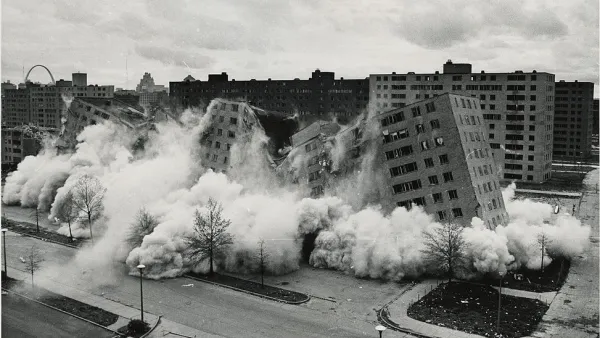
Michael Kimmelman, after visiting the Penn South housing cooperative in Manhattan and reflecting on the new film "The Pruitt-Igoe Myth", questions the role that design has in determining success or failure for tower in the park housing type.


A companion piece in some ways to the story we linked to earlier this week, Kimmelman considers the much maligned housing type that held such promise for providing a high quality-of-life for its residents when built en-masse in the 1950s and 1960s. Not all developments designed following the same Corbusian philosophy as Pruitt-Igoe shared its, now symbolic, fate. And Penn South is just one of Pruitt-Igoe's architectural cousins that thrived.
"Alienating, penitential breeding grounds for vandalism and violence: that became the tower in the park's epitaph. But Penn South, with its stolid redbrick, concrete-slab housing stock, is clearly a safe, successful place. In this case the architecture works. In St. Louis, where the architectural scheme was the same, what killed Pruitt-Igoe was not its bricks and mortar."
Read the full story: Towers of Dreams: One Ended in Nightmare
More Cities and Counties Arming Renters Against Source of Income Discrimination
St. Louis County is considering fair housing legislation that would prevent source of income discrimination, as many cities in the region have already done, and many more are also considering.
How Federal Housing Programs Built Segregation in St. Louis
St. Louis Public Radio details the work of a local researcher who says the segregation of today's St. Louis is the result of deliberate, decades-long federal housing policy.
The Massive Redevelopment Plans for North St. Louis Failed—What Next?
Detroit has Dan Gilbert, and for a few years, it looked like St. Louis had Paul McKee. Now that McKee's massive plans for the redevelopment of North St. Louis have failed expectations, what has been lost and what, potentially, can still be gained?

Planetizen Federal Action Tracker
A weekly monitor of how Trump’s orders and actions are impacting planners and planning in America.

Eastern Nebraska is running out of electricity
Data centers and electrification are straining eastern Nebraska’s grid, throttling economic development.

Study reveals best places in the U.S. for cycling, walking
New research from Streetlight Data examines bicycle and pedestrian miles per capita in the 100 largest U.S. cities by population.

Federal government nominates new FTA administrator
Mark Aesch is currently the founder and CEO of a transportation management consulting firm.

Developers reveal $10 billion stadium plan as ‘Hail Mary’ to keep Bears in Chicago
The plan would also boast a public park, high- and mid-rise buildings and a youth sports complex.

As Texas embraces carbon storage, a Black community questions the risks
Texas now issues permits for companies to store carbon dioxide underground. East Texas residents fear safety risks, and skeptics doubt the climate benefits.

FREE Course: Walkable City 1: Why Walkability?
After describing his path towards focusing on walkability as the essence of good planning, Jeff Speck marches through his five principal reasons for making more walkable places.
Reinventing Malls: Planning Alchemy—Turning Gray Fields Into Gold
The course focuses on the opportunities and imperatives that shape reinvention of mall sites.

City of Charlotte
City of Rosemead
Rutgers University, Edward J. Bloustein School of Planning and Public Policy
University of Michigan School for Environment and Sustainability (SEAS)
Hunter College, City University of New York (CUNY)
The Architects Foundation
City of Cambridge
The Pocatello Development Authority
The Urban Renewal Agency of the City of Pocatello