As readers of this blog will know I encourage people to find out about planning programs in multiple ways. Reading the work of faculty is a crucial first step as is reading the program’s web site. Visiting open houses or connecting with students (programs often set up some kind of chat space around admission time) are also options. Increasingly schools are using multiple forms of social media to reach current students and alums providing a useful window onto the programs for prospective students. This list highlights a few of these sources used specifically by planning programs.


As readers of this blog will know I encourage people to find
out about planning programs in multiple ways. Reading the work of faculty is a
crucial first step as is reading the program's web site. Visiting open houses
or connecting with students (programs often set up some kind of chat space
around admission time) are also options. Increasingly schools are using multiple
forms of social media to reach current students and alums providing a useful
window onto the programs for prospective students. This list highlights a few
of these sources used specifically by planning programs. There are many more of course, and
Jennifer Evans-Cowley has noted this in an interesting presentation as this
year's planning administrator's conference: http://www.slideshare.net/cowley11/acsp-administrators-social-media-21611:
-
MIT's Department of Urban Studies and Planning's
Alumni-Student group uses a public Facebook page to provide announcements,
student profiles, and reports of events: http://www.facebook.com/pages/MIT-DUSP-Community/76181914232?sk=app_23798139265
and it also has a blog at http://duspmeetup.wordpress.com/.
-
Cornell's Department of City and Regional Planning (where I
work) uses its blog to announce and report on events: http://cornellplanning.blogspot.com/.
It also provides resource lists-on topics like diversity or support groups on
campus. Fairly richly illustrated, it gives a sense of weekly activities on the
department. Cornell CRP's facebook page is more specifically focused on alums
but is also interesting: http://www.facebook.com/pages/Cornell-CRP-Alumni/198498036836379.
-
The Ohio State University has produced some excellent online
videos promoting planning and their program. "Be a Plannner" on the front page
of their program site is very good http://knowlton.osu.edu/planning
(or http://www.youtube.com/watch?v=ynqbEumyqYQ&noredirect=1)
but an earlier video in black and white, and now unavailable, blew me away and
made me want to rush to Columbus to study planning!
-
Berkeley is an example of a program where social media seems
to be organized at the college level. In the right menu of their main page at http://dcrp.ced.berkeley.edu/ one can
click on icons for the college's Facebook, Twitter, YouTube, and Flickr
accounts. While these sources have a lot of material from other departments,
the YouTube section has a number of interesting videos from planning.
As I prepared this it occurred to me that it would be useful
to have a master list of such social media. Perhaps Planetizen can provide it
in their next guide to graduate education.
This is my September
blog, rather late due to travel.
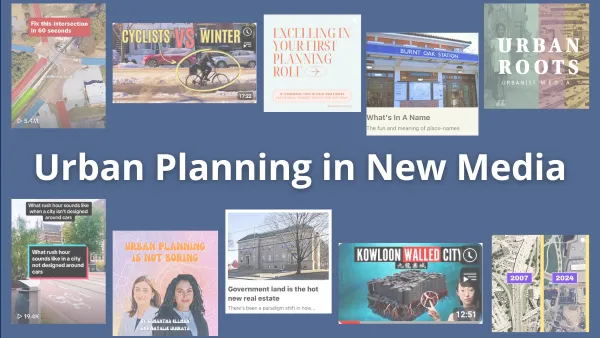
Urban Planning Creators You Should Know in 2024
Whether you’re a TikTok enthusiast or a Substack reader, you can find plenty of valuable and engaging urban planning content in the new media landscape.

Leveraging Social Media for Citizen Engagement in Urban Planning
Discover how urban planners can use social media to enhance citizen engagement, featuring strategies for interactive communication and community involvement in urban development projects.

Building Bridges to the Future: Preparing the Next Generation of Planners
Discover the importance of preparing the next generation of urban planners to build a sustainable and thriving future.

Planetizen Federal Action Tracker
A weekly monitor of how Trump’s orders and actions are impacting planners and planning in America.

Eastern Nebraska is running out of electricity
Data centers and electrification are straining eastern Nebraska’s grid, throttling economic development.

Study reveals best places in the U.S. for cycling, walking
New research from Streetlight Data examines bicycle and pedestrian miles per capita in the 100 largest U.S. cities by population.

DSA members accuse Mamdani of 'abandoning values' over housing redevelopment
New York City's mayor plans to replace about 2,000 units of public housing with private, mixed-income housing.

All sides of BRT debate unhappy with CDOT’s most recent move
The Colorado Department of Transportation is no longer considering center-running bus lanes for Colorado Boulevard.

Massachusetts bogs generate both power, and cranberries
Putting solar panels above farmland is one way Massachusetts is advancing toward its goal of net-zero carbon emissions by 2050.

FREE Course: Walkable City 1: Why Walkability?
After describing his path towards focusing on walkability as the essence of good planning, Jeff Speck marches through his five principal reasons for making more walkable places.
Reinventing Malls: Planning Alchemy—Turning Gray Fields Into Gold
The course focuses on the opportunities and imperatives that shape reinvention of mall sites.

City of Rosemead
Rutgers University, Edward J. Bloustein School of Planning and Public Policy
One Hundred Miles
University of Michigan School for Environment and Sustainability (SEAS)
Hunter College, City University of New York (CUNY)
The Architects Foundation
City of Cambridge
The Pocatello Development Authority
The Urban Renewal Agency of the City of Pocatello

