Dense downtowns provide more tax revenues for cities than strip mall and big box development on a per acre basis, according to a new study.


A new study takes a holistic approach to comparing tax revenue from big box development and downtown, mixed-use development. The study, commissioned by the Sonoran Institute, finds that on a per acre basis mixed use, dense dowtown development yields higher tax revenues for communities than their suburban mall counterparts.
The study's author, Joe Minicozzi, points out that in developments such as Glenwood Meadows "that the walk across the parking lot from Chili's restaurant to Target at the Meadows is equivalent to about a two-block walk in downtown Glenwood Springs, past numerous storefronts." The loss of revenue that is incurred because of the large expanses of parking lots is significant.
Economic development is a critical topic in many communities, especially in the current economic climate, and revenue information comparing different types of development may be useful in making land use decisions. The data from the study indicates that the Meadows development in Glenwood Springs brings in approximately $141,590 per acre, while the Denver Centre development in downtown Glenwood Springs brings in approximately $264,00 per acre.
Minicozzi notes that "'New urbanist' style downtown redevelopment, with its focus on mixing high-density residential with retail and commercial office space in a pedestrian-friendly setting, also tends to yield higher property values."
"Add the cost of public services to accommodate the needs of a large mall development compared to a dense downtown area, and the cost-versus-benefit numbers are even more telling, Minicozzi said."
Thanks to Cathie Pagano
Read the full story: Study: dense downtowns = higher tax yield

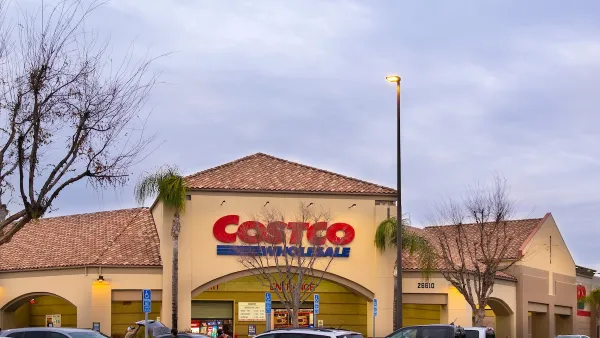
When Your Neighbor is a Big-Box Store
Taking advantage of state and local density bonuses and streamlining measures, beloved big-box retailer Costco is getting into the housing business
The First Urban Walmart
Walmart, famous for not budging on their store designs, may be ready to build an urban alternative with a handful of stores proposed for the D.C. area. Greater Greater Washington gets the scoop on the plans.
The nation's 10 'stickiest' downtowns
How often do residents visit your downtown?

Planetizen Federal Action Tracker
A weekly monitor of how Trump’s orders and actions are impacting planners and planning in America.

Amtrak, CN end decades-long dispute with eight-year agreement
The new operating agreement establishes an updated framework for the companies to work together, including processes to resolve disputes.

Northwest rail fans eager for Sept. 30 debut of Amtrak’s Airo fleet
Get ready for that new train smell and more seats. But they won’t go faster or run more frequently on the Cascades route in Washington and Oregon.

Trump administration unlawfully slashed $7 billion in clean energy grants, judge rules
The Environmental Protection Agency ended the Solar For All program, which provided the grants, after President Donald Trump’s inauguration.

Record-breaking wildlife overpass in Colorado brings 91% reduction in animal collisions
Prior to the overpass, vehicles were hitting one deer per day on Colorado’s Interstate 25.

California lawmakers approve just 5% of much-needed LA28 transportation funding
State legislators appear just as unwilling as Trump to pay for Olympics-related transportation projects.

FREE Course: Walkable City 1: Why Walkability?
After describing his path towards focusing on walkability as the essence of good planning, Jeff Speck marches through his five principal reasons for making more walkable places.
Reinventing Malls: Planning Alchemy—Turning Gray Fields Into Gold
The course focuses on the opportunities and imperatives that shape reinvention of mall sites.

City of Thousand Oaks
City of Wisconsin Rapids
Harvard University Graduate School of Design
The Architects Foundation
University of Cincinnati Online
The Pocatello Development Authority
The Urban Renewal Agency of the City of Pocatello