Public art plays a role in cities across the world. But what role exactly, and for what purpose? Glass House Conversations explores these questions in this series.


"Often the term Public Art is used interchangeably with Art in Public Spaces – parks, intersections, squares and the like. What is the function of art in these spaces and how does it connect to or serve the Public? Are the commissioners of such art fulfilling a public mandate or need?
Whose or which "Public Interest" is served by Urs Fischer's Untitled (Lamp/Bear) outside the Seagram building on Park Ave, in New York, a version of which will be auctioned by Christie's? A few blocks away, Ai Wei Wei's Circle of Animals/Zodiac Heads was opened with statements from the art world's luminaries, but where is the programming to further their meaning and significance to the public they serve?"
No Longer Empty, which redefines public art through temporary site-specific exhibitions, curates this discussion of public art's role.
Read the full story: What is the function of art in public spaces and how does it connect to or actively serve people?
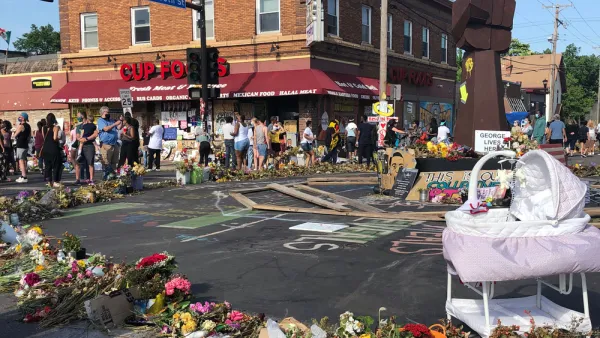
The Racial Reckoning in Public Spaces
Following George Floyd’s murder in 2020, there was an explosion of anti-racist street art across the country. “When we allow ourselves to release our emotions, oftentimes what is produced out of that is art.”
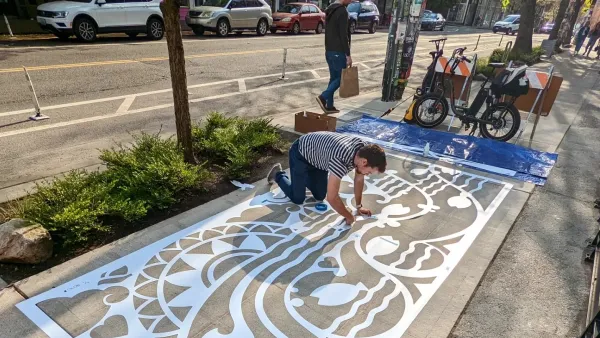
This Seattle sidewalk art only appears when it rains
Prompted to find a silver lining to the gloom of rainy Pacific Northwest days, an artist hit upon a novel solution: water-activated sidewalk paint.
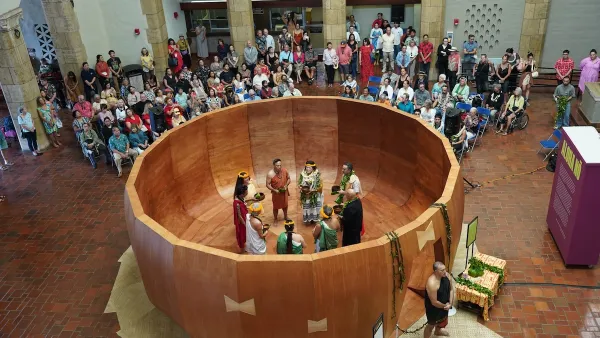
A Monument to Resilience: Native Hawaiian Art Installation Honors History and Healing
The towering ʻUmeke Lāʻau installation by Native Hawaiian artist Meleanna Aluli Meyer, unveiled at Honolulu's city hall, is a powerful symbol of cultural resilience and healing.

Planetizen Federal Action Tracker
A weekly monitor of how Trump’s orders and actions are impacting planners and planning in America.

Eastern Nebraska is running out of electricity
Data centers and electrification are straining eastern Nebraska’s grid, throttling economic development.

Move over, LA: St. Louis gears up for Olympics, invests millions in downtown redevelopment
The Missouri city will host the 2028 Olympic soccer group stage and knockout matches.

Dallas releases zoning code overhaul to officials
The drafted overhaul is over 400 pages long.

NYC renovations for dangerous, ‘mercilessly crammed’ street delayed until 2027
Construction was supposed to begin this fall.

San Diego’s Midway Rising project gets greenlight from city council
The project looks to become the largest affordable housing development in California's history.

FREE Course: Walkable City 1: Why Walkability?
After describing his path towards focusing on walkability as the essence of good planning, Jeff Speck marches through his five principal reasons for making more walkable places.
Reinventing Malls: Planning Alchemy—Turning Gray Fields Into Gold
The course focuses on the opportunities and imperatives that shape reinvention of mall sites.

City of Rosemead
Rutgers University, Edward J. Bloustein School of Planning and Public Policy
One Hundred Miles
University of Michigan School for Environment and Sustainability (SEAS)
Hunter College, City University of New York (CUNY)
The Architects Foundation
City of Cambridge
The Pocatello Development Authority
The Urban Renewal Agency of the City of Pocatello