Philadelphia is embarking on a long-term planning effort -- one in a string of many efforts over the past few decades. But this effort is different, compiling many small-scale plans for the city's future.


"We are once again living in a time of pulse-quickening civic visions, thanks both to Mayor Nutter, who has made good on his campaign pledge to untie the hands of city planners, and the William Penn Foundation, which has picked up the tab for many of the studies. The planning frenzy is a huge turnaround from the Rendell and Street years. It now feels as if a new report comes out every month.
Tuesday, it was the "Philadelphia 2035" vision plan. Modeled on the 1960 Comprehensive Plan, it marks the first time in half a century that Philadelphia's Planning Commission has taken time to sort out its long-range priorities and identify projects key to its future. The 2035 plan will inform every major decision the city makes in the next 25 years, whatever the inclinations of the mayor who succeeds Nutter."
The Philadelphia Inquirer's Inga Saffron writes that this small-scale approach makes sense, especially in times when finding the money to implement plans is tough.
Read the full story: Changing Skyline: A small-scale vision of Philadelphia's future
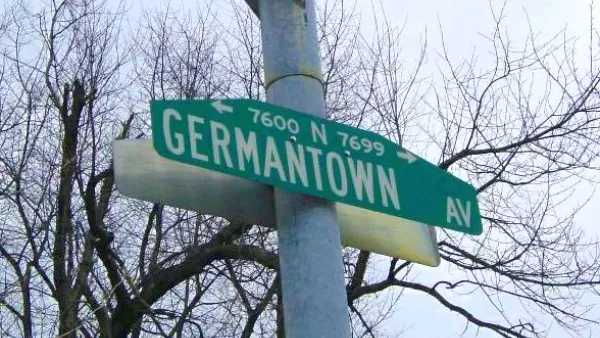
Neighborhood Rezoning Proposal at Odds With Philadelphia's Comprehensive Plan
While planning departments around the country make news for removing exclusionary zoning and parking requirements, many neighborhoods still show a strong preference for parking minimums and development limits. Case in point: Germantown, Philadelphia.
Planning Case Study: the Philadelphia2035 River Wards District Plan
Philadelphia planners are halfway through the Philadelphia2035 River Wards District Plan, which will help guide development and investment for a broad swath of troubled neighborhoods proximate to the Delaware River.
Strategic Plan for Philadelphia Land Bank Gains Approval
By all accounts, the Philadelphia Land Bank has completed a high quality strategic plan to guide its actions over the coming years.

Desperate measures: Advocates weigh draining Lake Powell to fill Colorado River
Draining the reservoir could reduce evaporation losses by a couple hundred thousand acre-feet.

Eastern Nebraska is running out of electricity
Data centers and electrification are straining eastern Nebraska’s grid, throttling economic development.

Malls are becoming the midtowns of the future
Mall and office park redevelopments are a generational opportunity to create new nodes of urbanity.

NYC breaks ground on anti-flooding infrastructure project
New York City's new system will reduce stormwater flows to local sewers by 90%.

One Kentucky town’s secret to affordable housing
The Smoketown Community Land Trust has already built seven affordable homes for community members.

Houston gains petal-shaped cooling infrastructure to make streets more ‘delightful’
The city has installed the pavilions along 15 blocks in Houston.

FREE Course: Walkable City 1: Why Walkability?
After describing his path towards focusing on walkability as the essence of good planning, Jeff Speck marches through his five principal reasons for making more walkable places.
Reinventing Malls: Planning Alchemy—Turning Gray Fields Into Gold
The course focuses on the opportunities and imperatives that shape reinvention of mall sites.

City of Rosemead
Rutgers University, Edward J. Bloustein School of Planning and Public Policy
One Hundred Miles
University of Michigan School for Environment and Sustainability (SEAS)
Hunter College, City University of New York (CUNY)
The Architects Foundation
City of Cambridge
Montrose County
The Pocatello Development Authority